Kilmarnock Corporation Tramways
History
Despite being approached several times by private companies that were interested in building and operating a tramway network in Kilmarnock, the corporation was not supportive of their schemes, preferring instead to pursue the creation of a municipally owned and operated system. This did not, however, meet with unanimous approval, several local figures strenuously opposing this, chiefly due to the significant expenditure it would entail, but also due to fears that such a system would end up being a drain on the public finances, a contention that was to prove prophetic. This eventually resulted in a ratepayers' referendum (in January 1903), which came down resoundingly on the side of those advocating a municipal tramway.
With the backing of the majority of its citizens, the council proceeded to apply for powers to construct 4.24 miles of electric tramway, these being granted on the 29th March 1904 by the Kilmarnock Corporation Order Confirmation Act 1904.
The corporation lost no time in starting construction of the tramway — circa June 1904 — the system opening six months later on the 10th December 1904. The system comprised a north-south line between the burgh boundaries at Beanburn and Riccarton, with a line branching off to Hurlford in the east — in the territory of Ayrshire County Council — from the centre of town. Apart from some track doubling in 1905, the standard-gauge, overhead electric tramway remained as built, and despite much municipal discussion, was never extended.
The main line ran southwards from the terminus in Beansburn, at the junction with Burns Avenue, via Dean Street and Portland Street to the Cross (where the branch to Hurlford diverged), continuing southwards along King Street, Titchfield Street, Glencairn Street and Campbell Street to Riccarton. The southern terminus was effectively in the middle of nowhere — the borough boundary — at the bridge over the Maxholm Burn, services inevitably running to and from the terminus either empty or almost empty. From the Cross, the Hurlford branch headed due east via Duke Street, London Road and Kilmarnock Road to the latter's junction with Riccarton Road and Galston Road in Hurlford.
The system was initially operated by 11 tramcars, these being joined by 3 more in 1905, taking the fleet to its maximum size of 14 vehicles.
The system was soon in trouble as there were simply insufficient passengers to generate the income necessary to cover both the operating costs and the debt repayments (interest and capital). This quickly led to economy measures, including dispensing with the services of the traffic superintendent, the motor inspector, and one of the ticket inspectors. The manager (of both the electricity and tramway undertakings) had very clear views on how to improve matters — including terminating services at Riccarton Station in the south, decreasing the frequency of services, and radically restructuring the fares, the latter allowing large numbers of passengers to travel far too cheaply — but was stymied at every turn by the Electric Committee, which was the council sub-committee with responsibility for the electricity and tramway undertakings.
One of the council's favourite pastimes was to wring its collective hands at the tramway's inability to make money, then commission a report from an independent expert to see what was wrong. These reports, of which there were several, repeatedly confirmed everything that the manager had already told the council; the latter would then either ignore the report's recommendations or implement a half measure that failed to address the underlying issues.
The fare structures were eventually addressed in 1910, a year that also saw significant expenditure on the Hurlford branch, which was suffering, and continued to suffer, from significant track issues caused by mining subsidence.
Like most tramway systems throughout the length and breadth of Britain, Kilmarnock Corporation Tramways suffered from the exigencies of the Great War, principally loss of men (and their skills) to the armed forces, coupled with severe restrictions on spares and new materials. The increasingly run-down state of the tramway inevitably drew criticism from the usual quarters on the council, with yet another report on the tramway exonerating the manager. Following the cessation of hostilities, efforts were made to put the tramway in order, as well as to address the impact of inflation, which made it imperative to raise fares, this granted under the Tramways (Temporary Increase in Charges) Act 1920.
The manager was finally freed of the burdensome tramway in 1920, the council deciding that it needed separate managers for its electricity and tramway undertakings.
Much expenditure was incurred in 1921 sorting out the badly deteriorating track and trackbed on the Hurlford Road, which was an absolute necessity, yet money was then squandered relaying the track south of Riccarton Station, a section of tramway that hardly saw any passenger usage. 1921 also saw the introduction of motorbus competition along the Hurlford line by the Scottish General Transport Company, initially with protective fares, though these were soon lowered, with other bus operators quickly joining the fray. The council, or rather its key officers, completely failed to regulate the motorbus competition, preferring a 'wait and see' approach to obtaining the necessary powers.
In 1924, the new manager reported on the costs of completely relaying the Hurlford line, versus the cost of replacing it with either trolley bus or motorbus services. Needless to say, this did not make pretty reading for the tram lobby, and a decision was taken to apply for powers to operate motorbuses. These were granted on the 14th July 1924 under the Kilmarnock Corporation Order Confirmation Act 1924
The council lost no time in ordering 8 motorbuses, the first entering service on the 6th December 1924, with the last tram on the Hurlford line running on the 15th December 1924.
Despite the closure of the Hurlford line, the corporation continued to maintain the main line, completing a programme of track repair in mid 1925. However, just half a year later, on the 26th January 1926, the Tramways Committee recommended that the tramway be abandoned and that the services be replaced by motorbuses. The full council endorsed the recommendation on the 10th March 1926. Powers to abandon the tramway were duly applied for, these being granted on the 4th August 1926 under the Kilmarnock Corporation Order Confirmation Act 1926.
Events, however, now overtook the tramway, the last services running on the 3rd May 1926, not because that was the closure date, but because it was when the tramway services ceased during the General Strike of 1926, the council simply choosing not to recommence them.
In spite of the constant criticism from certain quarters of the council, the tramway system was actually very well run, its flatness contributing to the lowest running costs of any tramway in Britain. This one fact is perhaps a fitting indictment of the decision to build the tramway in the first place, as whatever was done in terms of operational efficiency, there were simply not enough passengers to make it a viable proposition.
Uniforms
Tramcar crews were initially issued with uniforms of grey whipcord cloth piped in green. Jackets were single-breasted with five buttons (bearing the full system title and municipal coat of arms — see link), two slit breast pockets and fold-over collars; apart from the buttons, the entire ensemble was devoid of insignia. The tensioned-crown peaked caps probably bore standard, off-the-shelf, script-lettering grade badges — either 'Motorman' or 'Conductor' — which were presumably brass to match the buttons. These particular uniforms proved to be unsatisfactory (they did not wear well), so were quickly replaced by more robust navy jackets, still single-breasted, but now with button-closure breast pockets and stand-up collars; the latter bore system initials — 'K C T' — on the bearer's left-hand side (in individual letters), and an employee number on the right-hand side (in individual numerals), all more than likely in brass.
Inspectors wore single-breasted jackets edged in a finer material than the main jacket, and with hidden buttons (or more likely an hook and eye affair), one slit breast pocket and stand-up collars; the latter bore the grade — 'Inspector' — in embroidered script lettering (on both sides). The cap was in the same style as worn by tramcar crews, and bore a hat band of a lighter colour, which seems to have been an affection much favoured on Scottish tramway systems; the hat band bore a large badge of unknown pattern, possibly incorporating a municipal device. Kilmarnock also employed the services of a chief inspector, who appears to have been issued with a uniform that was identical in style to those worn by inspectors, but with the grade — 'Chief Inspector' — on the collars.
In common with the vast majority of UK tramway systems, Kilmarnock employed the services of women during the Great War (as conductresses from 1915, and motorwomen from 1916) to replace male staff lost to the armed services, and like many provincial Scottish systems, it continued to employ them right through the 1920s. Photographs of female staff are, however, yet to come to light, so it is currently unclear what uniforms they wore.
Further reading
For a history of the tramway, see: 'Kilmarnock's Trams and Buses' by A W Brotchie and R L Grieves (N B Traction; 1984).
Images
Motormen and conductors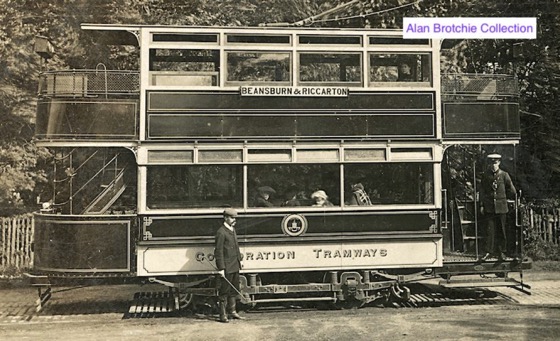
A newly delivered top-covered tramcar (No 13), in pristine condition, dating the photograph to 1905.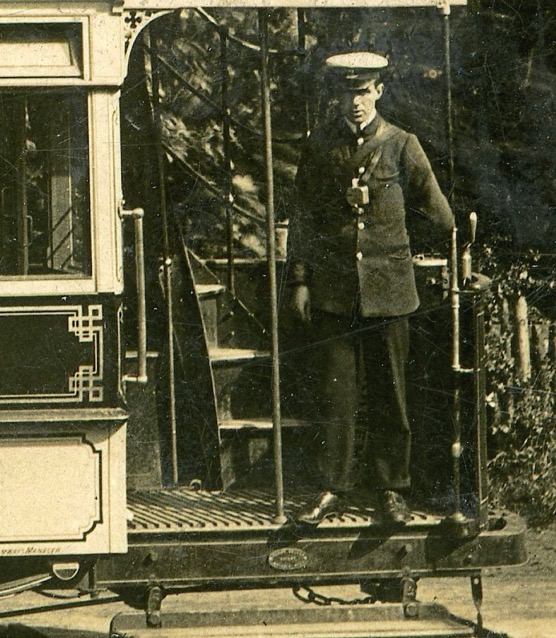
An enlargement of the above photograph showing the conductor on the rear platform; his jacket is single-breasted with slit pockets, and appears to be devoid of insignia, though there is a hint of a badge on the cap.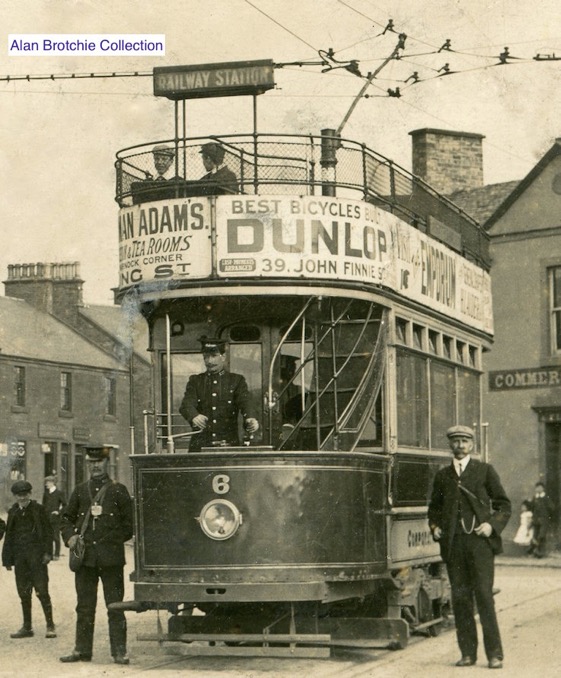
The crew of Tramcar No 6 captured for posterity at the Hurlford terminus, probably around 1906/7 (taken from a postcard dated 1908). By this time the earlier uniforms had been replaced by a more robust design.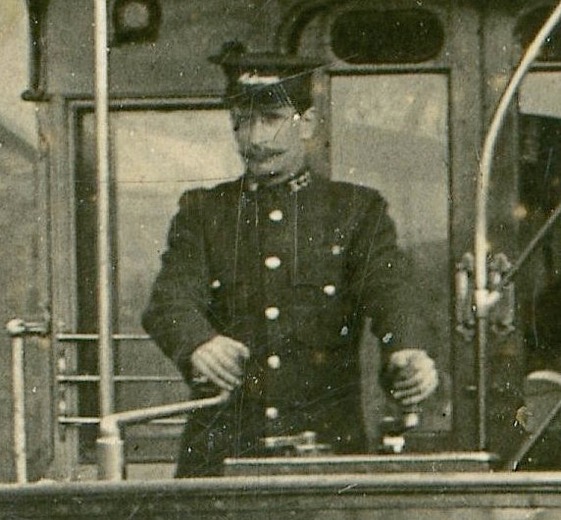
An enlargement of the above photograph showing the motorman, who clearly spent some time on his personal appearance, judging by his impressive moustache.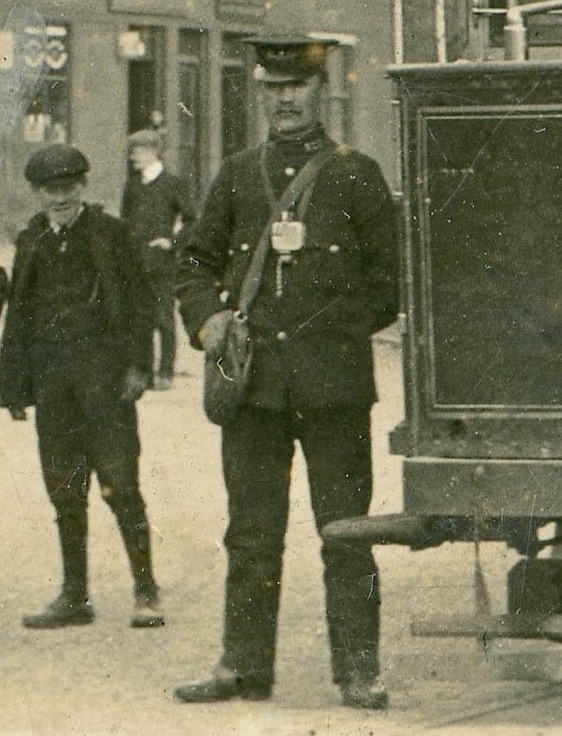
Another blow-up of the above photograph, this time showing the conductor, whose left-hand collar bears the system initials, 'K C T'.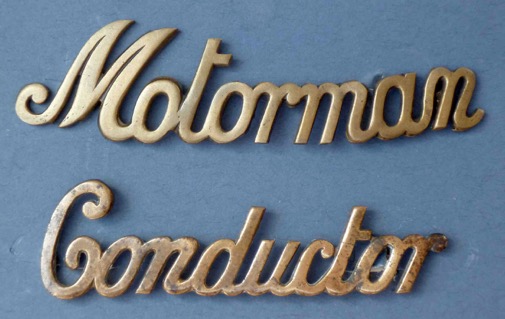
General pattern script-lettering cap badges — 'Motorman' and 'Conductor' — of the type used by Kilmarnock Corporation Tramways.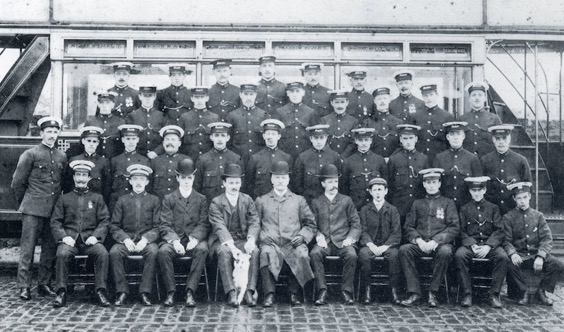
A depot photo taken in 1906, and featuring: the manager (with dog), the chief inspector, two inspectors, twelve motormen, and seventeen conductors (two part time). Photo reproduced with the kind permission of Brian Deans.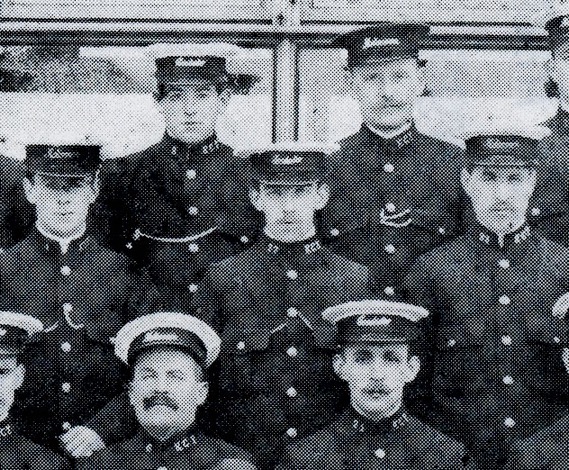
An enlargement of the above photograph showing three of the motormen and three of the conductors. The collar insignia are fairly easy to make out.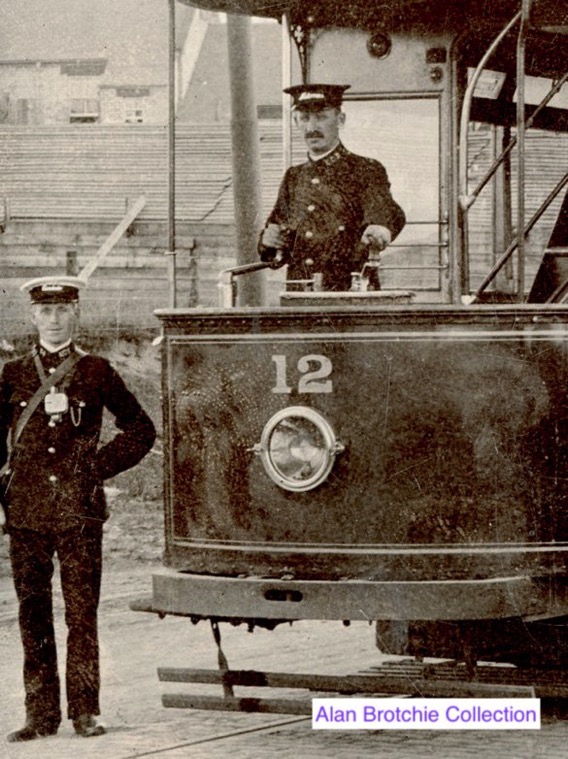
A conductor and a motorman stand with their charge — Tramcar No 12 — at what is possibly the terminus at Beansburn around 1910. Both men have 'K C T' system initials on their left-hand collars, and the standard script-lettering grade badges on their caps.
Senior staff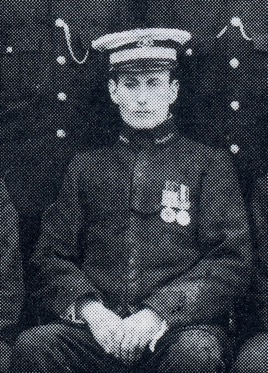
An enlargement of the 1906 staff photograph above showing one of the inspectors (or possibly the chief inspector). His cap bears a band of a lighter colour than the rest of the cap, above which is a large badge of unknown pattern. This appears to be the same badge that is seen on the caps of the two part-time conductors, so was presumably a 'municipal-device badge rather than a marked inspector's badge. The subject's medals were presumably for Boer War service.