Maidstone Corporation Tramways
History
Although proposals were put forward for a horse tramway in Maidstone as early 1880, nothing came of these. Interest in building a tramway, this time electric, resurfaced in 1900, and after commissioning a report from a tramway consultant, the council eventually decided to proceed with an application. Powers were duly obtained on the 9th December 1903 via the Maidstone Corporation Light Railway Order (1903), though the mileage approved (two miles) was less than had been sought (2.5 miles) and the gauge was reduced to 3ft 6ins.
Construction commenced in late 1903, with the line from High Street to Barming opening for passengers on the 14th July 1904. The line, in isolation, was too small to be a financial success, and did not serve large areas of the town, so the council always viewed it as the first step in building a larger system. Unfortunately, the council soon ran into difficulties with its application for a further 4.5 miles of tramway (submitted in November 1904), primarily due to the narrowness of several thoroughfares. Somewhat unusually, this application was held in abeyance (as opposed to being withdrawn) as discussions proceeded on how best to meet the objections of the Light Railway Commissioners, with a second application being made (in November 1906) for an additional 1.25 miles of tramway to Tovil, that it was clearly hoped would prove less controversial. This was indeed the case, both applications being reviewed together, approval for the Loose line being given in January 1907 under the Maidstone Corporation Extension Order 1907, and approval for the Tovil Line following on the 9th December 1907 under the the Maidstone Corporation (Extension No. 2) Order 1907. The 'go ahead' for the Tovil line must have been given prior to the approval of the order, as construction commenced well before of the latter.
The Loose line commenced revenue-earning service on the 16th October 1907, followed by the Tovil line on the 9th January 1908. These lines took the 3ft 6ins-gauge, overhead electric tramway system to its final size of 5.25 miles. The system was centred on High Street, the Barming line running westwards along Broadway and Tonbridge Road to a terminus near the 'Fountain' at the junction with Terminus Road; the Loose line running southwards via Mill Street, Upper Stone Street and Loose Road to a terminus near the 'Links Arms' on Old Loose Hill; and the Tovil line branching off the Loose line in Mill Street, then heading broadly southwestwards along College Road, King Edward Road and Tovil Road to a terminus just short of 'The Rose' on Tovil Hill.
The initial services were delivered using 6 tramcars, another vehicle being added in 1905, followed by 10 tramcars in 1907 (to work the new lines), and the final car in 1909. The latter vehicle, which was one-man-operated, was purchased in order to bring costs down on the loss-making Tovil line, its arrival bringing the tramcar fleet to its final size of 18 vehicles.
As with every tramway system, the Great War brought immense challenges to the tramway, most obviously through the loss of men (and their skills) to the armed forces, the entire conducting staff eventually being female, along with six motorwomen. Following the conclusion of the conflict, the corporation's thought's turned to an extension of the tramway system to serve the northeast of the town, though nothing came of it. The corporation seems to have maintained strict control over independent bus operators, such that none of them would run a service within the town under the conditions imposed by the corporation. The latter's response was to explore its own options, including municipally operated motorbuses and/or trolleybuses. Powers to this end were obtained on the 18th July 1923 under the Maidstone Corporation Act (1923). The corporations' first motorbus service commenced on 7th April 1924, with operations gradually expanding during the decade.
The tramway system was, however, ageing, such that both the track and the vehicles would soon need major expenditure. On the 27th February 1924, the council formally decided to replace the tramway with trolleybuses as and when major tramway expenditure was required.
The name of the operating department was changed in January 1926 to Maidstone Corporation Transport to reflect the expansion into motorbus operation and presumably, the coming switch to trolleybus operation. Further trolleybus powers were granted on the 29th July 1927 under the Maidstone Corporation (Trolley Vehicles) Order Confirmation Act (1927). The first 8 trolleybuses entered service on the 1st May 1928, replacing the trams on the route to Barming. The Tovil line was the next to go, the trams being replaced with motorbuses on the 1st August 1929. This left just the Loose line, the last tram of all running on the 11th February 1930, trolleybuses taking over the next day.
The tramway initially proved to be a financial burden, with modest profits that were wholly insufficient to cover the loan charges. The situation worsened dramatically following the opening of the Loose and Tovil lines, losses being made from 1909 to 1913, which had to be made good by the ratepayers. Although the Great War brought increased loadings and the losses were gradually reduced, this was not enough to eliminate them entirely. Things were, however, dramatically turned around after the war, when ticket prices were increased, the tramway ironically entering a period of sustained profitability, as it was run down, such that a Reserve and Depreciation Fund of £30,000 had been built up by the time the system closed.
Uniforms
Tramcar staff were issued with single-breasted jackets with five buttons (bearing the corporation municipal device — see link), two breast pockets (with button closures) and stand-up collars; the latter bore an employee number on the bearer's left-hand side, in individual numerals, and system initials — 'M C T' — on the right-hand side, in individual letters. The insignia and buttons were brass. The tensioned-crown peaked cap bore a standard, off-the-shelf, script-lettering grade badge — either 'Motorman' or 'Conductor' — above which a shield-shaped municipal-device badge was mounted. The style of uniform remained unchanged for the entire life of the system, from the inauguration of electric services in 1904 through to their replacement by trolleybuses in 1930.
Tramcar crews were also provided with double-breasted greatcoats with five pairs of buttons and high, fold-over collars; the latter bore identical insignia to the jackets worn underneath, i.e., an employee number on the bearer's left-hand side and system initials on the right.
Photographs of inspectors are yet to come to light, so it is currently unclear what uniforms they wore.
In common with the majority of UK tramways systems, Maidstone employed female staff during the Great War — both as conductresses and as motorwomen — to replace male staff lost to the armed services. These ladies were issued with tailored, single-breasted jackets with five buttons, two breast pockets (with button closures) stand-up collars and long matching skirts; the collars carried the same insignia as the jackets worn by their male colleagues. The peaked caps had a wide tensioned crown (top), a common form of headgear used across the country for female tramcar staff; they carried the standard grade and municipal-device badges.
Female staff were also issued with long, double-breasted, lancer-style greatcoats with five pairs of buttons — narrowing from top to bottom — and high fold-over collars. They appear to have carried system initials — 'M C T' — on the bearer's right-hand collar.
Further reading
For a history of Maidstone Corporation Tramways, see: 'The Tramways of Kent — Volume 1, West Kent' by Invicta; The Light Railway Transport League (1971).
Images
Motormen and conductors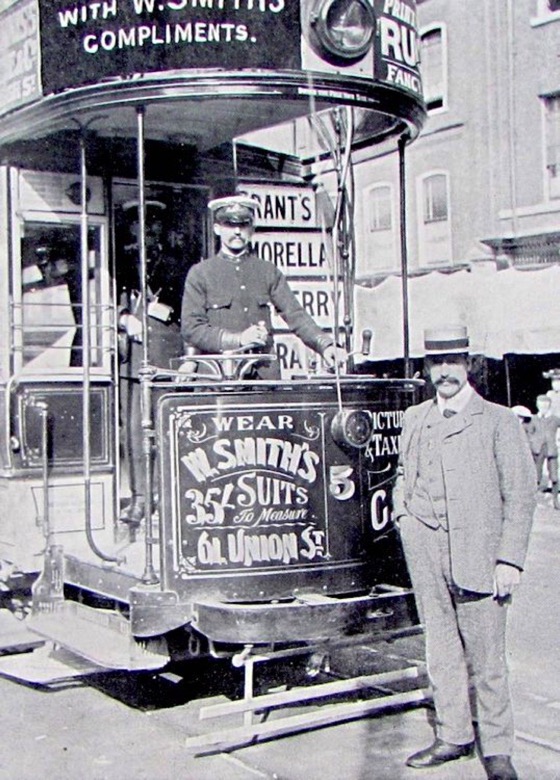
Tramcar No 5 and its motorman, posing for a shot which was used as a local trade card publicising 'W Smith's suits' — photo undated, but probably mid-Edwardian. The motorman is wearing a single-breasted tunic with stand-up collars, along with a tensioned-crown peaked cap bearing a script-lettering grade badge — 'Motorman' — and a shield-shaped municipal-device badge. Photo in the public domain.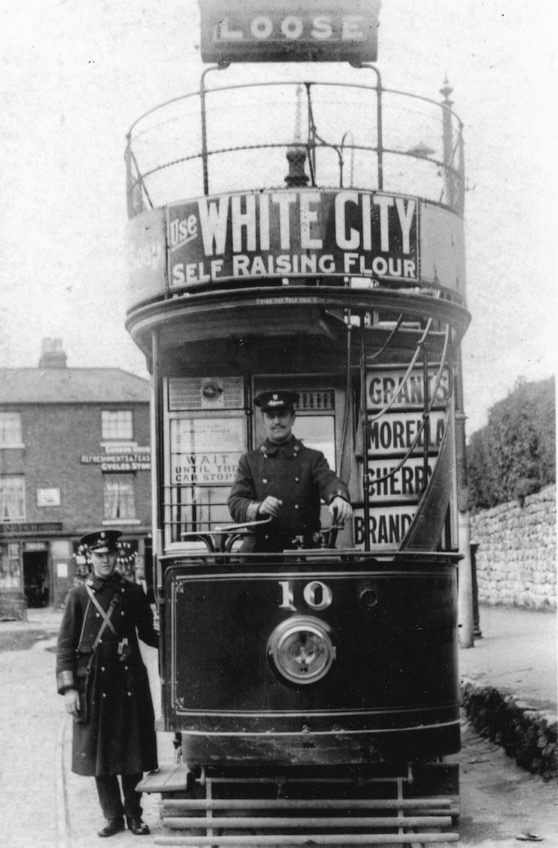
The crew of Tramcar No 10 at the Loose terminus — photo undated, but judging by the relatively good condition of the vehicle, probably taken in the late-Edwardian era. Author's Collection.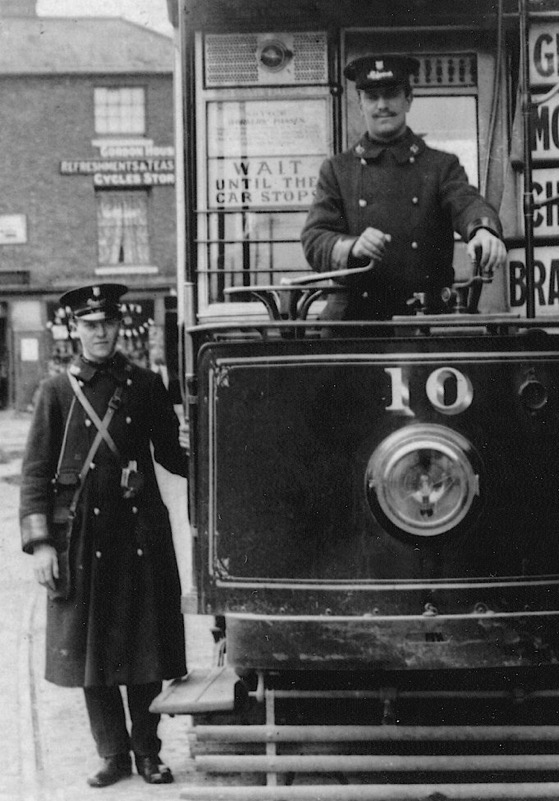
An enlargement of the above photograph showing the conductor and the motorman, both of whom are wearing greatcoats. The collars have an employee number on the bearer's left-hand side and individual systems initials — 'M C T' — on the right-hand side. The tensioned-crown peaked caps bear a grade badge, above which is a municipal-device badge.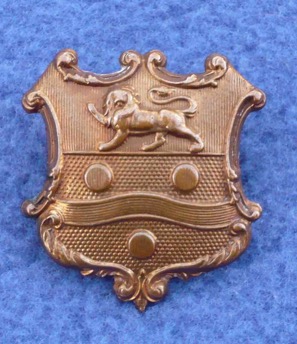
Maidstone Corporation Tramways municipal-device cap badge — brass.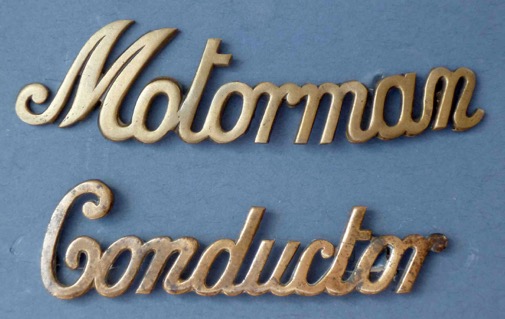
'Off-the-shelf', script-lettering grade badges — 'Motorman' and 'Conductor' — of the type used by Maidstone Corporation Tramways; brass. Author's Collection.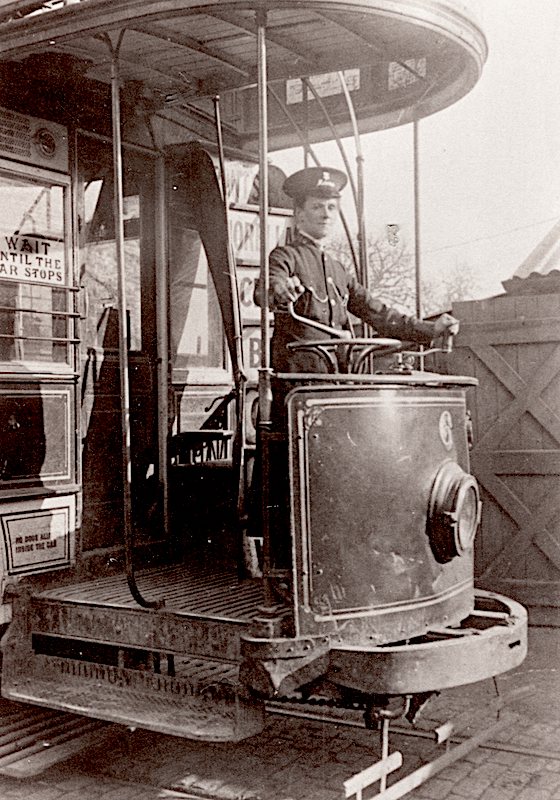
A commercial postcard view of a motorman on board the platform of Tramcar No 6 — photo undated, but thought to have been taken shortly before the Great War.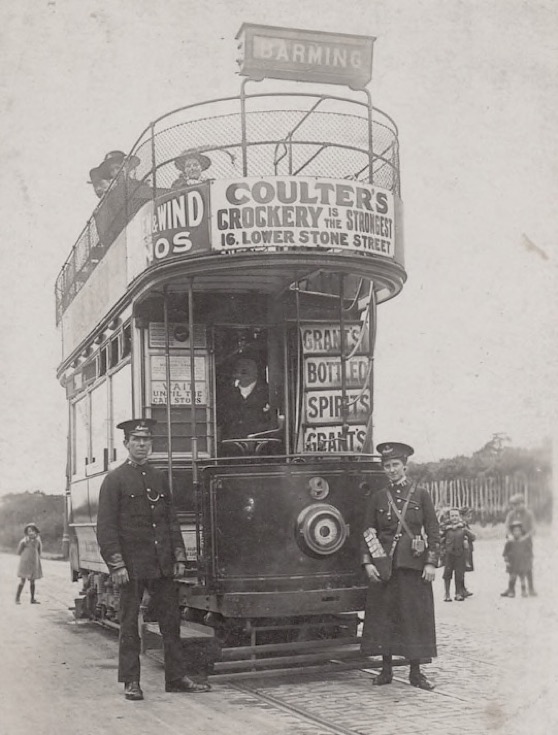
A motorman and a conductress with Tramcar No 9 on the Barming route, probably along Tonbridge Road — photo undated, but almost certainly taken during the Great War. Source unknown.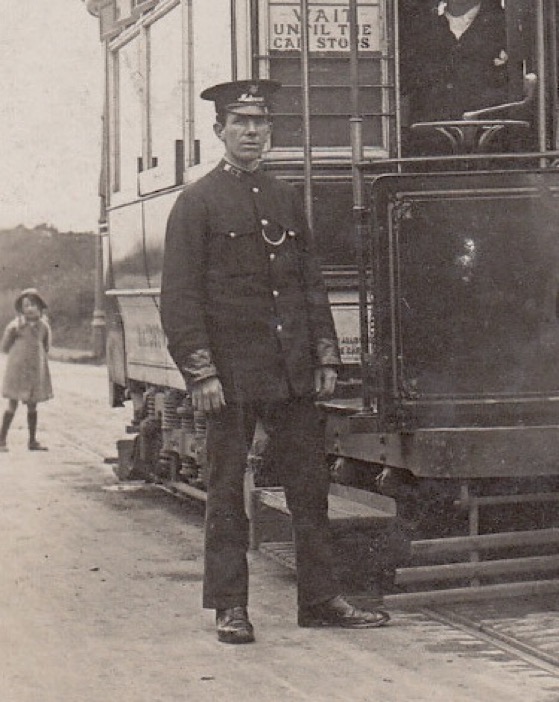
An enlargement of the above photograph showing the motorman. His cap bears a script-lettering grade badge — 'Motorman' — and the standard municipal-device badge, whilst his right-hand collar bears system initials, ' M C T'.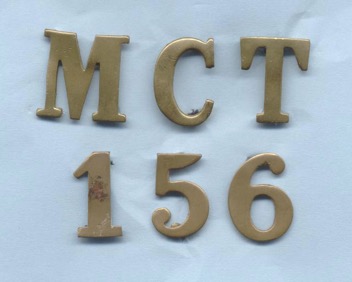
Maidstone Corporation Tramways collar badges — brass. With thanks to the Stephen Howarth Collection.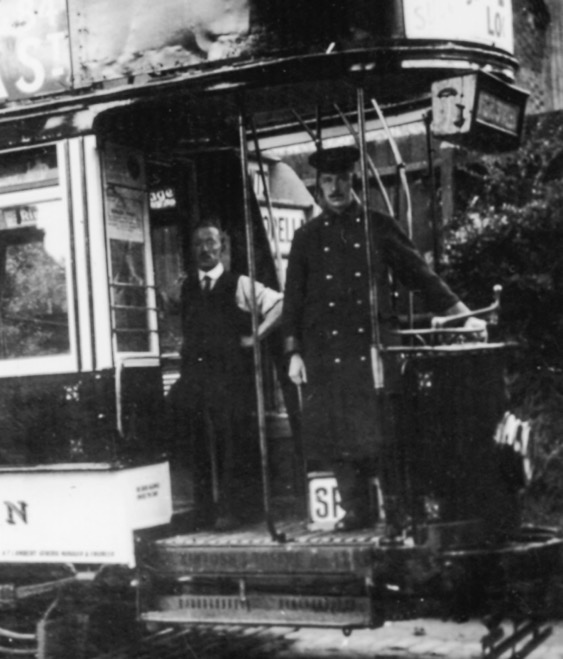
An MCT motorman in double-breasted greatcoat aboard the platform of an unidentified tramcar in the depot yard in 1929. Photo courtesy of the Tramways and Light Railway Society, with thanks to David Voice.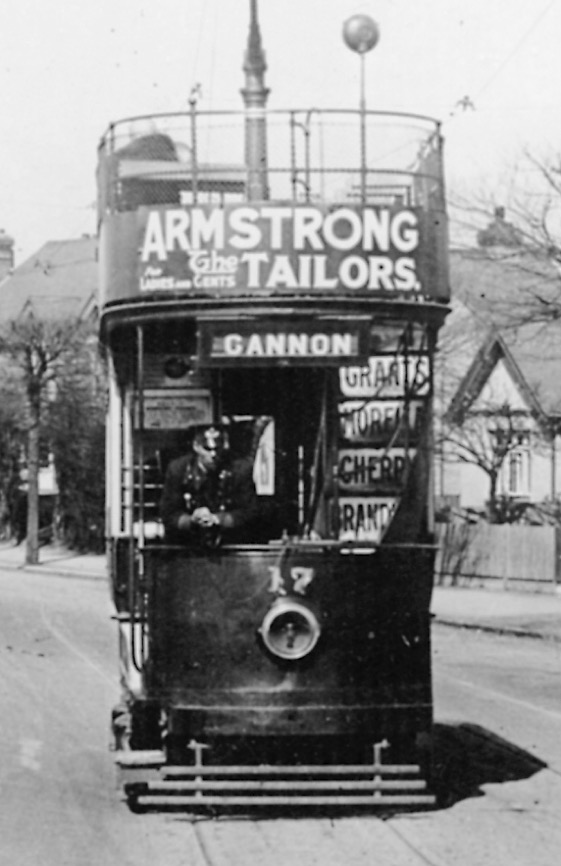
The motorman of Tramcar No 17 leans rather wearily on his dash in Loose Road — photo undated, but almost certainly taken in the late 1920s. Photo courtesy of the Tramways and Light Railway Society, with thanks to David Voice.
Female staff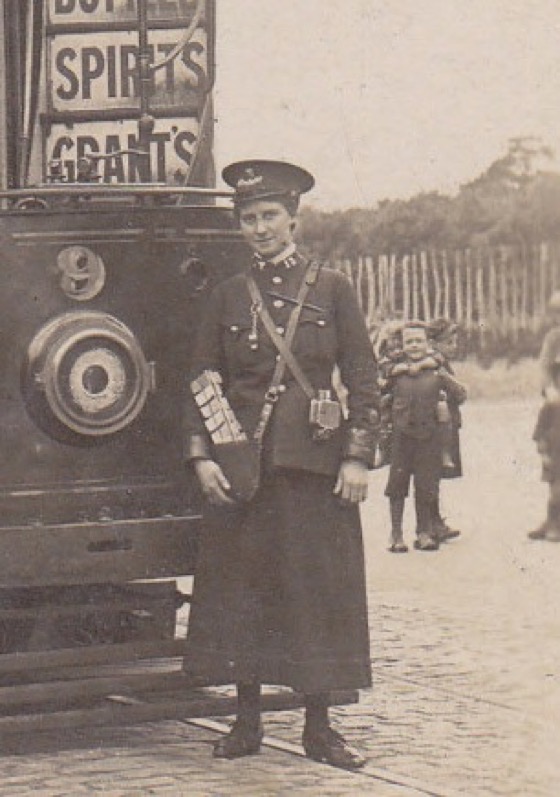
An enlargement of the Great War shot of Tramcar No 9 above, showing the conductress.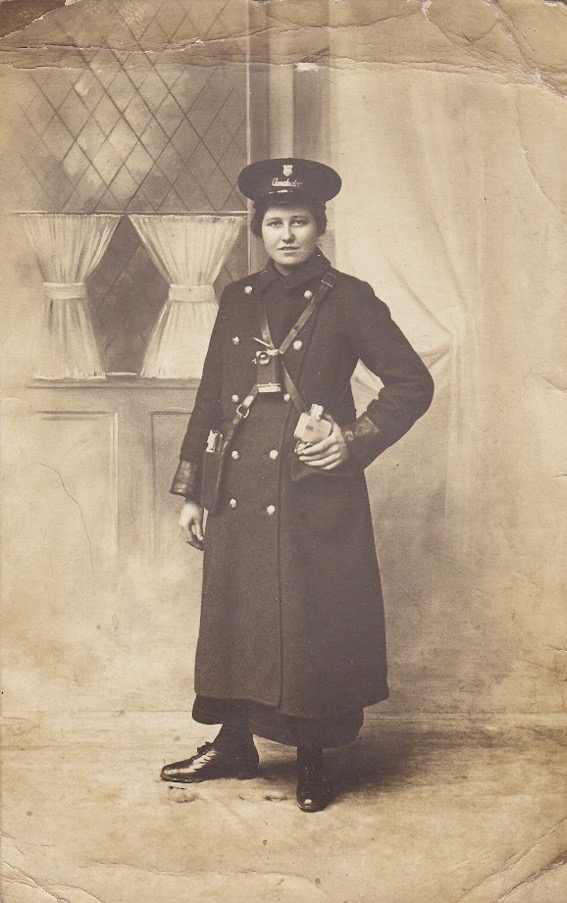
A rare studio portrait of a Great War Maidstone Corporation Tramways tram conductress. Photo courtesy of the Stephen Howarth Collection.