Portstewart Tramway
History
The Portstewart Tramway was a typical Irish roadside tramway with some street running, and came about as a consequence of the nearest railway, which opened in 1855, being around two miles distant from the town. Several attempts were made to plug the gap between the town and the railway station (the latter initially called Portstewart Station, but later on Cromore Station) with a railway, but none came to fruition. Powers to build a roadside steam tramway were eventually acquired on the 26th April 1880 under an Order in Council, which also incorporated a company — the Portstewart Tramways Company Limited — to raise the necessary capital, and to build and operate the line. Although not promoted by the railway company — the Belfast and Northern Counties Railway Company — it was nevertheless heavily involved with it, purchasing a large number of shares and providing the PTCo with a substantial loan.
The 1.85-mile, 3ft 0ins-gauge steam tramway opened to the public on the 28th June 1882, and was operated from the outset by the B&NCRCo. From Portstewart Station, the line ran roughly northwestwards along Station Road, past Mill Lane to Portmore Road, which it then followed westwards to Victoria Terrace, before turning southwards along the Parade (nowadays the Promenade) to a terminus near the former Montagu Arms Hotel, the tram depot being situated on the east side of the Parade almost opposite the Crescent. The tramway was operated on railway principles with three intermediate request stops, one halfway along Station Road (at Mill Lane), the second at the junction of Portmore Road and Station Road (Golf Links Halt), and the third at the western end of Portmore Road (Victoria Terrace).
Services began with a single Kitson & Co. steam tram engine (No. 1), which was only joined by a second (No. 2) on the 28th September 1883, the delay most likely being due to the company having insufficient funds to order two engines from the off. Realistically speaking, the tramway was never going to be a money spinner, especially as its traffic was to a large extent seasonal, so it is perhaps no surprise that the PTCo only managed to pay a dividend to its shareholders once in its first nine years of operation. The situation was not helped by financial impropriety on the part of a B&NCRCo auditor who absconded with a large sum of the B&NCRCo's money, as well as some of the PTCo's. The fact that some of the PTCo's key employees also worked for the B&NCRCo, ultimately led to considerable friction between the tramway and the railway company, the former accusing the manager (employed by both concerns) of only looking after the B&NCRCo's interests.
By 1891, the tramway could no longer service its debts, a receiver being appointed in November. It is likely that the B&NCRCo continued to operate the tramway on behalf of the receiver, the railway company eventually writing off £600 the tramway company owed it, presumably in order to keep the concern operating. In January 1896, the PTCo was subjected to a winding-up petition, which was accepted by the Master of Rolls on the 4th February 1896, the latter authorising the sale of the tramway on the 1st March 1897. The only bidder for the debt-ridden concern was the B&NCRCo, which duly took over on the 1st June 1897. The legal loose ends were formally tied up two years later on the 13th July 1899, when the purchase was confirmed by the Belfast and Northern Counties Railway Act, 1899.
The B&NCRCo quickly set about putting the tramway in order, relaying the track and overhauling the services, all of which led to an upward swing in passenger numbers. Another steam tram engine (No. 3) was acquired in 1901, which gave more operational flexibility.
On the 1st July 1903, the B&NCRCo was taken over by the Midland Railway Company, the tramway thereafter falling under the jurisdiction of the Midland Railway Northern Counties Committee. The tramway continued to operate through the Edwardian era and the Great War, occasionally making a small profit, until it became part of the London, Midland and Scottish Railway Company upon the latter's creation on the 1st January 1923, the undertaking thereafter being operated as part of the LMS Northern Counties Committee. By this time the tramway was extremely run down, little having been done in the way of maintenance for many years, its parent company presumably being reluctant to throw any more money the way of the loss-making concern. It was therefore no surprise when the LMS NCC announced, on the 22nd September 1925, that it intended to close the line on the 30th January 1926. Despite protestations from Portstewart Urban District Council, the closure duly went ahead, tramway services being replaced by motorbuses operated by a Mr S. S. Henry.
Uniforms
Unfortunately, there are no surviving photographs of tramway staff taken prior to the 1920s, so it is unclear what uniforms would have been worn by steam tram drivers and conductors. However, given that the tramway was certainly owned and operated by the B&NCRCo between 1897 and 1903, and operated by it prior to that, it seems highly likely that conductors — at least — would have worn railway company uniforms. Up until 1903, the uniform buttons would have been those of the B&NCRCo, from 1903 to 1923 those of the MR NCC, and thereafter (1923 to 1926) those of the LMS NCC (see link).
A single photograph has survived that appears to have been taken in the very early 1920s, i.e. in MR NCC days. This shows a steam-tram driver wearing a cotton jacket and trousers, along with a soft-topped peaked cap of typical railway design; it is unclear whether the jacket or the hat bore any badges, though the photograph would tend to suggest not. The conductor is wearing a single-breasted jacket with lapels, the collars of which bear some kind of insignia, possibly embroidered company initials; the conductor is also wearing a waistcoat, which is typical of railway rather than tramway practice. The conductor's cap, which is in a kepi style, seems to have borne a large, unusually shaped cap badge (akin to the cross-section through a loaf of bread) which was very probably of embroidered cloth.
Following the tramway's absorption into the LMS NCC in 1923, steam tram drivers appear to have been issued with single-breasted jackets with metal buttons. Conductors' jackets do not appear to have changed — stylistically — from the earlier jackets. The kepi-style caps, however, were superseded by a tensioned-crown type (with an unusually wide crown); the new caps bore a hat band, which probably carried embroidered lettering, most likely company initials or a grade.
The tramway appears to have operated its trains (often consisting or an engine, two trailers and a luggage/parcels van) with three employees, namely: a driver, a conductor and one other; it is currently unclear what the precise duties of the third individual were, though he may have been a porter-cum-guard. In the 1920s, the third crew member wore a single-breasted jacket, though seemingly more robust than that issued to the conductor, and without collar insignia. His peaked cap was soft-topped, a typical railway style, and carried a metal badge of some description, most likely a standard MR NCC or LMS NCC issue, depending on the period.
Photographs of tramway inspectors have not come to light, and it may well be that the tramway never employed them, given that it was operated according to railway practice. Likewise, and unlike the vast majority of British mainland tramways, there is no evidence that the company employed the services of women during the Great War.
Further reading
For a history of the tramway, see: 'The Portstewart Tramway; Locomotion Papers No 41' by J R L Currie; The Oakwood Press (1968).
Images
Steam tram drivers and conductors/guards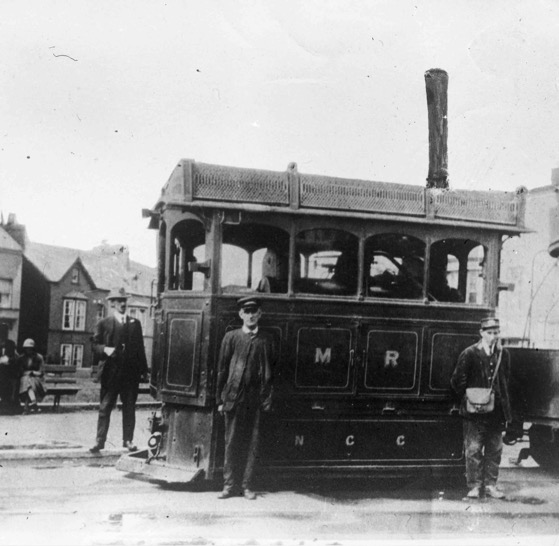
Steam Tram No 3 (Kitson & Co. No T302 of 1901), poses with its crew. Although the photo is undated, from the fashions on display, as well as the livery, which is pre-1923, it is likely that it was taken in the early 1920s. Photo courtesy of the National Tramway Museum. 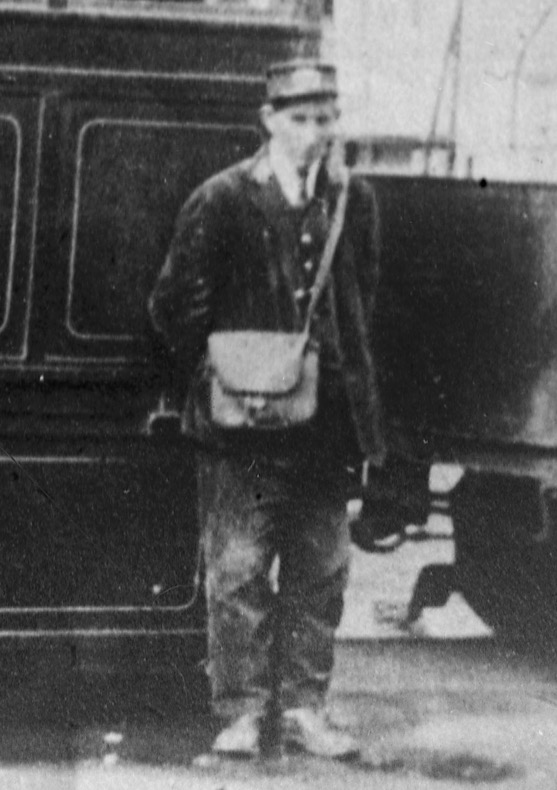
An enlargement of the above photograph showing the conductor. He is wearing a uniform jacket and a kepi-style cap that bears a large cap badge shaped like the cross-section of a bread tin; it is likely that the badge was embroidered cloth.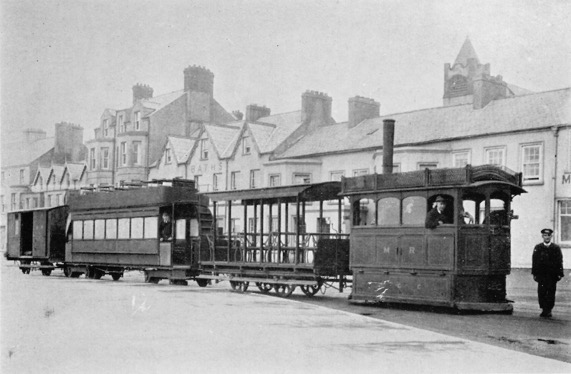
The crew of what would appear to be Steam Tram No 3 pose for the cameraman on the Parade, Portstewart — photo undated, but probably taken in the 1920s. Photo courtesy of the Tramways and Light Railway Society, courtesy of David Voice.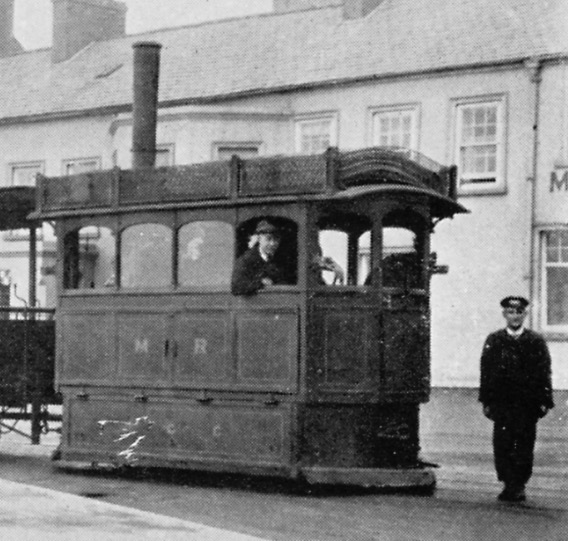
An enlargement of the above photograph showing the driver, and another tramwayman, whose precise role is unclear, given that the conductor can be seen standing on the trailer platform in the uncropped photo above. Whatever his grade, he is clearly wearing a uniform and a cap with a metallic cap badge.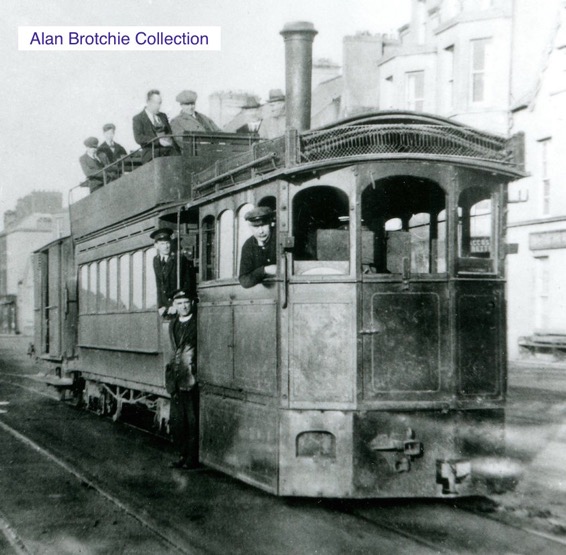
Steam Tram No 1 (Kitson & Co. No T56 of 1882) posed for the camera on the Parade, Portstewart — photo undated, but probably taken between 1923 and 1926.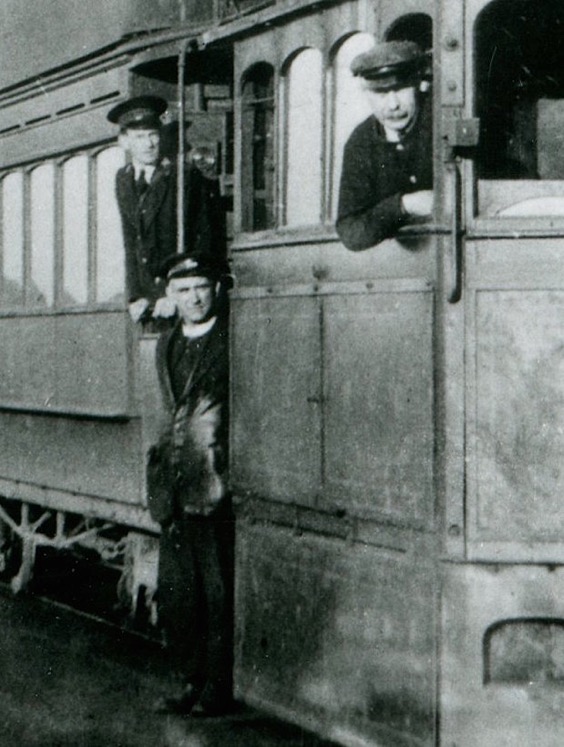
An enlargement of the above photograph showing the conductor (on the trailer platform); he is wearing a uniform jacket with collar insignia and a tensioned-crown peaked cap with an embroidered hat band. The driver is wearing typical railway-footplate attire. The grade of the man between the engine and trailer is unclear, but he is certainly wearing a uniform, and with a soft-topped railway-style cap with what would appear to bear a metallic cap badge.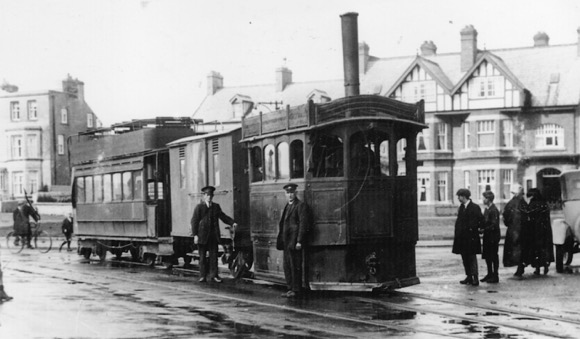
The crew of Steam Tram No 3 pictured in Victoria Terrace, Portstewart — photo purportedly taken in 1925. The engine is still in MR NCC livery, despite the amalgamation which created the LMS NCC having taken place over two years previously. Photo courtesy of the Tramways and Light Railway Society, courtesy of David Voice.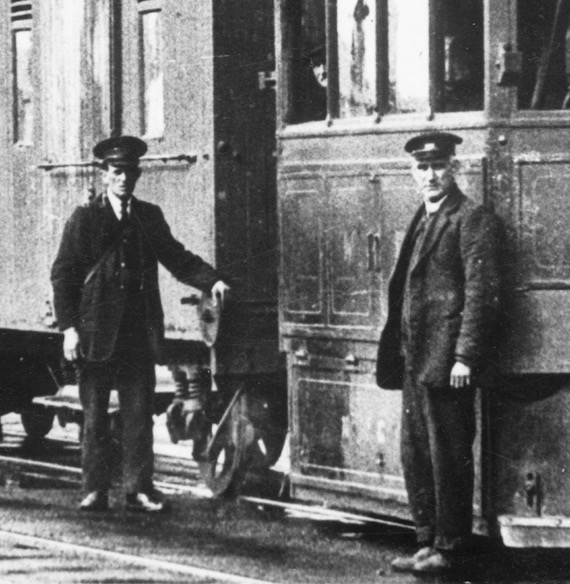
A close up of the above photograph showing the conductor (left), the driver (in the cab), and another tramway employee, possibly a porter-cum-guard; they are clearly the same men as in the third 'Parade' photo above, and are all similarly attired. Photo courtesy of David Gladwin, with thanks to Trevor Preece.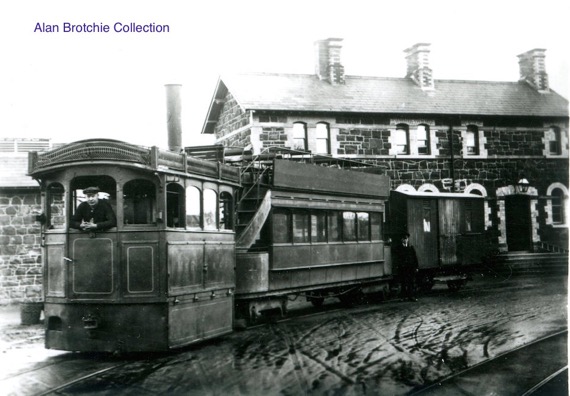
Steam Tram No 2 (Kitson & Co. No T84 of 1883) sits at Portstewart Station — photo undated, but probably taken not long before closure.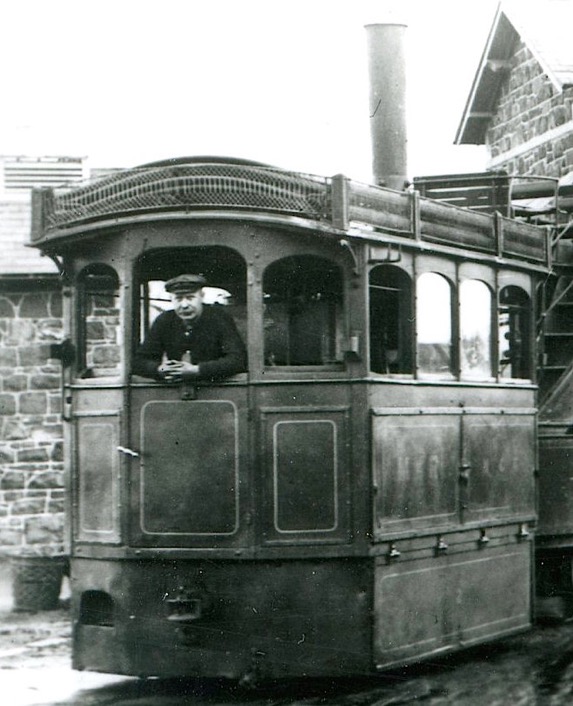
An enlargement of the above photograph showing the driver, who is almost certainly the same man as in the preceding photo. His jacket clearly has metallic buttons, so it was in all probability an LMS NCC issue.