Preston Corporation Tramways
History
Preston Corporation obtained powers to build 5.5 miles of tramway, to be operated by horse or mechanical power, on the 2nd August 1880, under the Preston Improvement Act of 1880. Just ten days later, on the 12th August 1880, the town's existing horse tramway operator — the Preston Tramways Company (see link) — were granted powers, under the Preston Tramways Act of 1880, to lease any new lines built by the corporation, strongly suggesting that an agreement had been reached between the two, as at this time, municipal authorities were prevented from operating tramways under the provisions of the Tramways Act of 1870.
Construction of the corporation-owned tramway, which was built to a gauge of 3ft 6ins, the same as the company's tramway, began on the 14th April 1882, the first services commencing during Preston Guild Week (September 1882). For reasons that are now unclear, the corporation did not lease operation of its system to the PTCo, but to W. Harding & Company, who also horsed the tramcars of the PTCo. The corporation's 5.5-mile long system, and the PTCo's 2.5-mile long line, appear to have been worked completely independently, and may not even have been connected (this is unclear).
The corporation was, however, not content to share the town with a private tramway operator, but was instead keen to have all the town's tramways under municipal control. A price was eventually agreed with the PTCo for the corporation to purchase the company line and its tramway assets, the PTCo running its last horse tram on the 31st December 1886, and Hardings taking over operation the next day (as the lessee of the corporation).
Hardings worked the corporation horse tramway throughout its entire life (1882 to 1903), which at its maximum totalled around 8 miles. The former PTCo line ran northwards from a terminus opposite the Town Hall, along Lancaster Road, North Road and Garstang Road, then eastwards along Victoria Road and Watling Street to a terminus at Fulwood Barracks. The corporation-built lines ran: eastwards from a terminus at the bottom of Fishergate Hill, along Fishergate, Church Street and Newhall Lane to a terminus in Blackburn Road, Farringdon Park; the other line branched off northwestwards near the Town Hall, along Friargate, Fylde Road, Tulketh Road, Wellington Street, Tulketh Avenue and Newton Road to a terminus in Long Lane, Ashton-on-Ribble. It is assumed that after the corporation took control of the former PTCo line, it was connected up to the corporation-owned lines.
The corporation eventually decided that the horse tramway should be converted to overhead electric traction, and after much discussion, it eventually decided to apply for powers to do so, these being granted on the 30th July 1900 under the Preston Corporation Act of 1900. Here matters now rested, the corporation seemingly plagued with indecision, and not for the last time. In the end, new powers were sought, these being granted on the 23rd June 1902 under the Preston Corporation Act of 1902. A comparison of the two reveals that the gauge was changed (from 4ft 0ins in 1900 to 4ft 8½ins in 1902), and the extent of the tramway was increased (11.3 miles in 1900 versus 14.6 miles in 1902), as was the amount of double track, which in the new act amounted to 8.6 miles (i.e., 59% of the system).
Work on the new electric system commenced around February 1903, the horse trams continuing to run until the end of Harding & Company's lease on the last day of 1903, whereupon the horse-tram system was closed, with temporary omnibus services being introduced, these being provided by Harding & Company.
The first corporation electric service commenced on the 7th June 1904 along the former horse tramway route to Fulwood, with other lines following on fairly quickly, the system essentially assuming its final form on the 26th January 1905, with the opening of the Ribbleton route. Although the corporation was relatively forward looking in terms of its tramcars and new technology (e.g., automatic point changers and trolley reversers) it could never seem to make up its mind about how to extend the system, extensions being repeatedly discussed, and even agreed upon, but none being built, leaving large areas of the town without tramway provision. When the corporation did finally make its mine up to proceed with a parliamentary bill in 1913 — powers being granted on the 31st July 1914 under the Preston Corporation Act of 1914 — the Great War fatally intervened. The act did, however, include powers to operate motorbuses within the borough.
Despite the corporation's vacillations, the tramway was very profitable, regularly paying substantial sums to the relief of rates, with plenty left over for renewals, which the Tramways Department seems to have always been on top of. The Great War of course led to a drop-off in maintenance and an inability to purchase track, spares or new tramcars, but the system seems to have emerged from it in better shape than many other concerns. After the end of the conflict, and despite increased operating costs and inflationary pressures, the corporation found the money to continuing investing in the system, replacing track, buying secondhand cars and completely rebuilding others. Unfortunately, the corporation's ingrained habit of deferring decisions, or taking them then doing nothing further, continued after the war, with various track alterations being authorised and then not carried out, with perhaps the biggest waste of municipal effort being expended on the acquisition of powers to operate trolleybuses, which it then made no use of.
The corporation finally dipped its toes into motorbus operation in 1922, its first services commencing on the 23rd January. Further bus routes were introduced in 1924, one of which — to Ashton Lane Ends — resulting in the closure of the terminal end of the Ashton tram line, which looped back to Ashton from Tulketh Road, a service which was then no longer needed. Although new bus services continued to be introduced during the 1920s, investment in the tramway nevertheless continued up to around 1929, when the corporation developed an interest in trolleybuses, obtaining powers to operate them, and to replace the trams, on the 21st March 1931 under the Preston Corporation Act of 1931. Whilst nothing was to come of this, a metaphorical line had been crossed in terms of tramway abandonment, and the anti-tram faction on the council now had the upper hand.
In order to reflect its increasing reliance on buses, the name of the department was changed in the summer of 1931 — to Preston Corporation Transport — and early the following year (on the 18th January 1932) the decision was taken to convert the Farringdon Road and Penwortham lines to petrol-bus operation, both lines being in need of expensive track renewal. Buses took over on these routes on the 4th July 1932, though it is believed that some trams continued to run for a short while afterwards, probably when there weren't enough buses to cover the services. The Ashton and Ribbleton lines went in 1933, leaving only the circular, which lasted until 1935, the last tram of all running on the 15th December that year.
Preston Corporation's standard-gauge, overhead electric tramway extended to 10.53 miles, comprising lines from the centre of town (Church Street): northeastwards to Ribbleton; eastwards to Farringdon Park; westwards to the bottom of Fishergate then southwards to Penwortham Bridge; northwestwards to Ashton; and a loop line northwards to Withy Trees, then eastwards to Fulwood, then southwards along Deep Dale Road to join the Ribbleton Route and thence back to Church Street. The tramway remained isolated all its life, so was never connected to another tramway system.
The system was initially worked with 30 tramcars (all delivered during 1904). These were followed by 3 cars in 1912, 6 in 1914, 9 in 1920 (secondhand from Sheffield Corporation Tramways) and the last of all, 3 in 1929 (again secondhand, but from Lincoln Corporation Tramways). The fleet was also continually modified and upgraded, so although rather aged by the time of closure, many tramcars had undergone significant rebuilding and modernisation.
Uniforms
Although Preston Corporation was a horse tramway owner from 1882 to 1903, it never operated the services itself, instead leasing them to a private company, W. Harding & Company. Although numerous photographs of horse-tram crews have survived, these are predominantly from the last 15 years or so years of operation, so what follows below is based largely upon that evidence; nevertheless, given that these photographs clearly show that horse-tram car crews did not wear uniforms, there is currently no reason to think that this was any different in the early years (1880 to 1885). Both drivers and conductors wore smart but informal attire, namely: jackets, trousers, shirts and ties, along with the fashionable headgear of the day, predominantly the bowler hat, but also the flat cap. The latter was presumably a development of the mid-to-late 1890s, when these came into vogue. Drivers sometimes also wore leather aprons. No insignia of any kind appears to have been worn, including municipal licence badges.
Early photographs indicate that uniforms had not been delivered (or ordered) in time for the inaugural electric services, so crewmen simply wore informal but smart attire, invariably topped off with a flat cap. However, relatively soon after services began, uniforms were introduced; these consisted of double-breasted lancer-style tunics with five pairs of buttons (narrowing from top to bottom, and presumably in brass — see link), epaulettes and stand-up collars. The collars carried an employee number (in individual numerals) on both sides, presumably in brass to match the buttons, whereas the epaulettes bore system initials, 'P C T' in individual letters, though they may have initially been plain, i.e., without badges. The tensioned-crown peaked caps bore script-lettering grade badges (again presumably brass), either 'Driver' or 'Conductor'. The style of uniform does not appear to have changed at all over the entire 30-year history of the electric system.
Given that the name of the undertaking was changed in 1931, it is highly likely that issues of new uniforms after this date would have borne 'Preston Corporation Transport' buttons.
Tramcar staff were also provided with long, double-breasted greatcoats with five pairs of buttons and high, fold-over collars; the latter carried employee numbers on both sides, again presumably in brass.
Inspectors were probably issued with single-breasted jackets with hidden buttons (or more likely a hook and eye affair) and stand-up collars, with the jacket and pockets edged in a finer material than the main body. The bearer's left-hand collar appears to have born the grade — 'Inspector' — in embroidered script lettering; it is unclear what the other collar bore. The tensioned-crown peaked caps also carried the bearer's grade — 'Inspector' — on a hat band, in embroidered script lettering.
In common with the vast majority of UK tramway systems, Preston employed women during the Great War, as conductresses (from 21st May 1915 onwards), to replace male staff lost to the armed services. Female staff were issued with single-breasted, tailored jackets with four pockets (with button closures), epaulettes and stand-up collars, along with long matching skirts; the collars carried an employee number on both sides. Headwear was similar to the men's caps, but with a much wider tensioned crown; they carried the same script-lettering grade badges that were used on the men's caps.
Further reading
For a history of Preston's tramways, see: 'The Tramways of Preston' by G W Heywood, in the Tramway Review, Nos 67 (p67-77/92), 68 (p99-124), 69 (p131-146), 70 (p163-167/181-191), 71 (p207-212) and 77 (p154-160); Light Railway Transport League (1971, 1972, and 1974).
Images
Horse tram drivers and conductors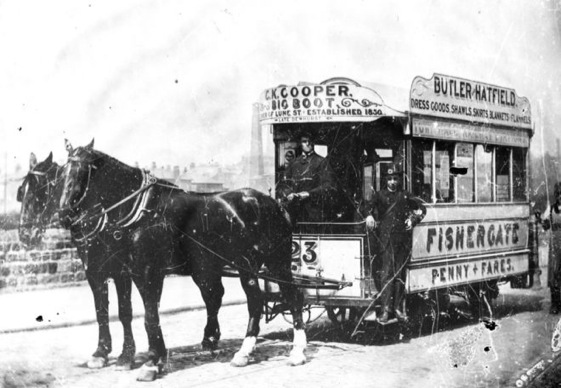
A single-deck horse car (No 23) and crew in Fishergate, Preston — photo undated, but given the style of dress and the elaborate vehicle livery, almost certainly taken in the early years of corporation ownership, i.e., the 1880s. Both men appear to be wearing informal but smart attire. Photo courtesy of the Tramways and Light Railway Society, with thanks to David Voice.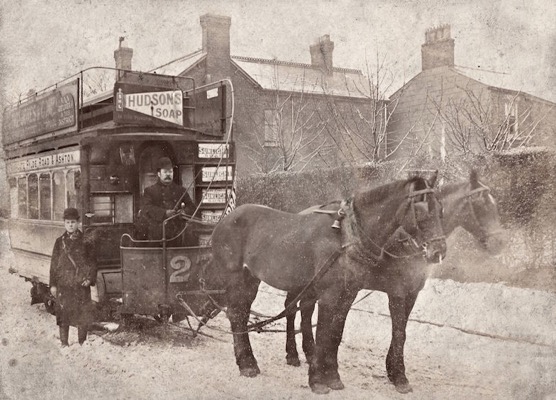
Horsecar No 27 stands in Newton Road, Ashton — photo undated, but from the style of the bowler hats (with upturned brims), possibly taken in the late 1880s. Photo courtesy of Barbara Quinn via the Preston Digital Archive (see link).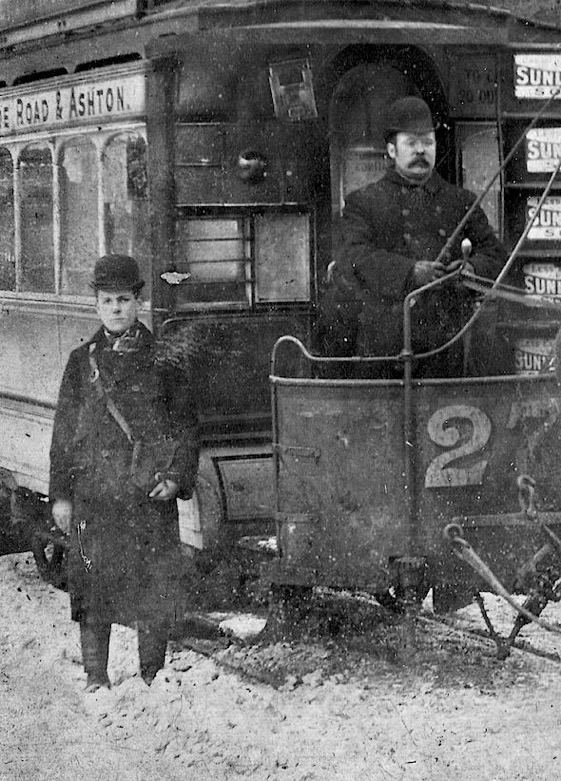
An enlargement of the above photograph showing the crew, both of whom are wearing bowler hats typical for the late 1880s. Both men are wearing informal attire with no evidence of badges or licences.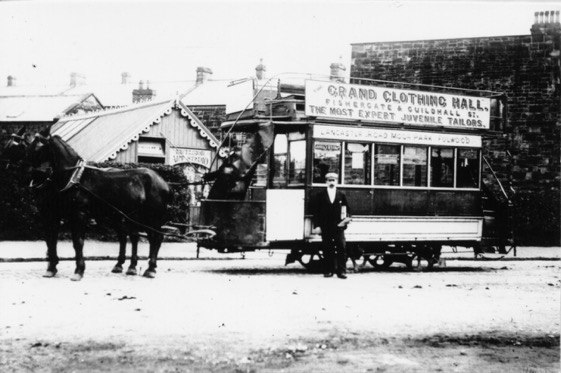
A horsecar driver and a conductor pose for the camera outside the Excelsior Art Studio on the Lancaster Road to Fulwood Barracks route — photo undated, but given the conductor's flat cap, probably taken in the mid-to-late 1890s. Photo courtesy of the Tramways and Light Railway Society, with thanks to David Voice.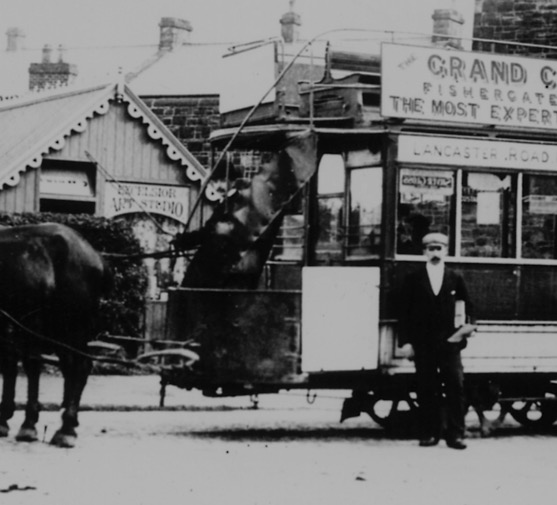
An enlargement of the above photograph showing the driver, in a long coachman's coat, and the conductor in an informal jacket; the former is wearing a bowler hat and the latter, a flat cap.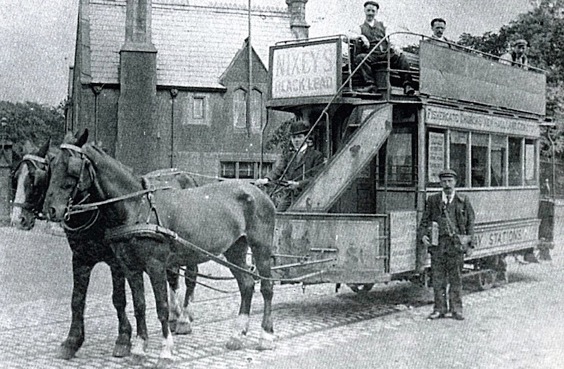
A driver and a conductor at Cemetery Gates — photo undated, but probably turn of the century. Photo courtesy of Preston Digital Archive (see link).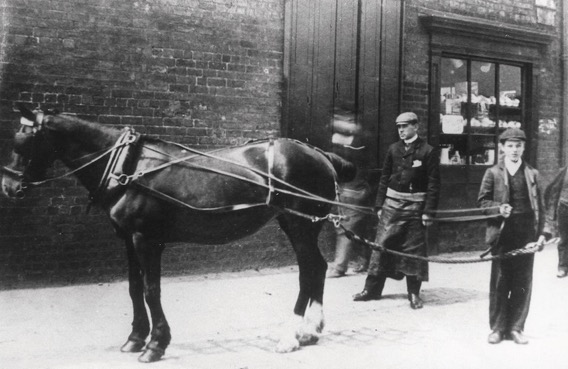
A driver and his helper (possibly a stable lad or trace-horse boy), change their horse around at the bottom of Fishergate, possibly in 1903. The driver is wearing a leather apron. Photo courtesy of Preston Digital Archive (see link).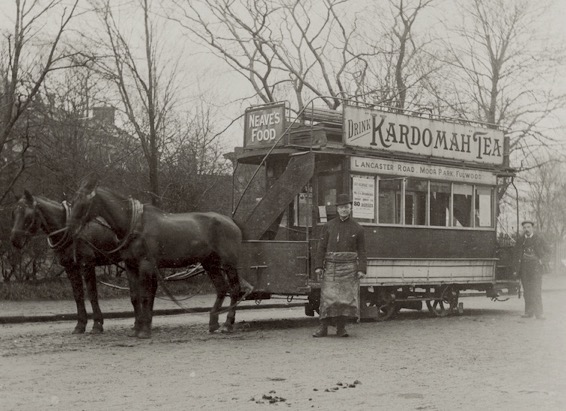
A horse-tram driver and his conductor with an unidentified horse car near Fulwood Barracks in late 1903. Photo courtesy of the National Tramway Museum. 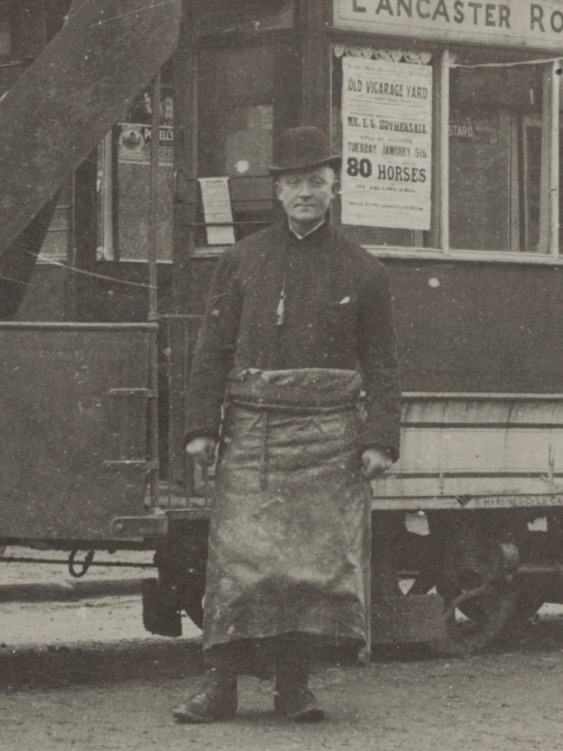
An enlargement of the above photograph showing the driver. The poster on the tram advertises the coming sale of 80 horses on January 5th, presumably 1904 given that W. Harding & Company's lease was ended on the last day of 1903.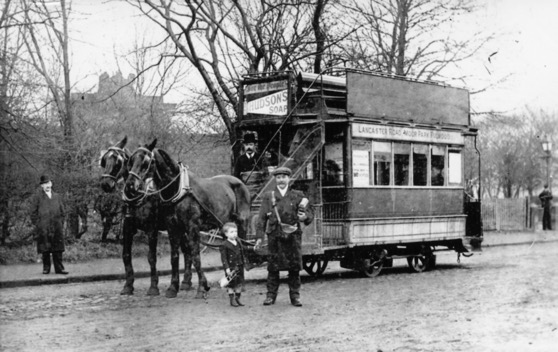
A rather charming photograph of a Preston horse tram driver, a conductor and a young boy, possibly the conductor's son — taken near Fulwood Barracks in late 1903. Photo courtesy of the Tramways and Light Railway Society, with thanks to David Voice.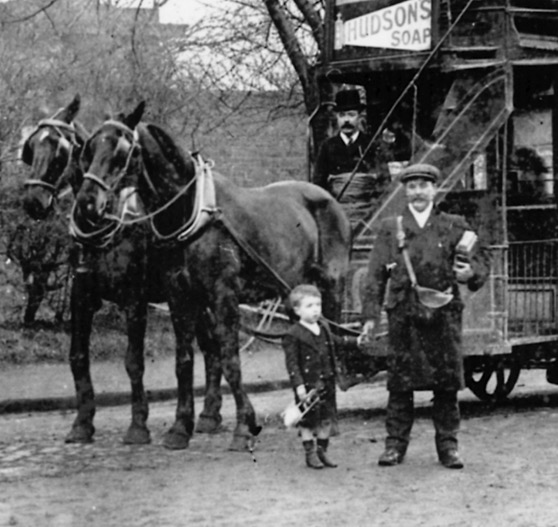
An enlargement of the above photograph showing the driver (with blanket and bowler hat) and the conductor (in smart informal jacket and a flat cap).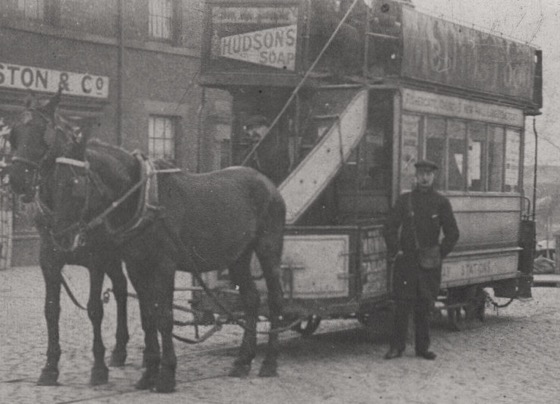
A driver and a conductor with their rather battered-looking charge at the bottom of Fishergate Hill — photo purportedly taken on the last day of operation, 31st December 1903. Photo courtesy of Preston Digital Archive (see link).
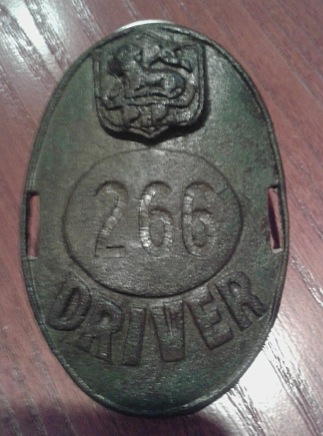
Preston licence badge — brass. There is no photographic evidence to support this type of licence ever being issued to horse-tram drivers, so in all likelihood, it was for private hire and/or horse bus drivers. With thanks to Chris Gardiner.
Motormen and conductors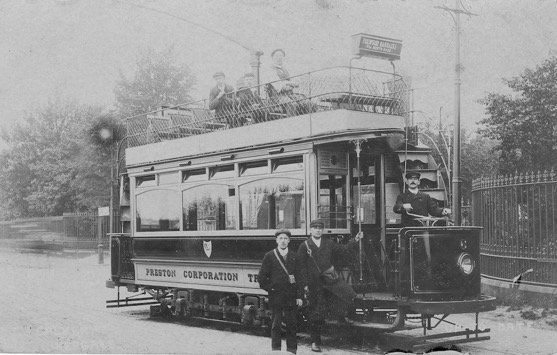
Two conductors and a motorman with what would appear to be a brand new Tramcar No 6 on a service for Fulwood Barracks — photo undated, but almost certainly taken in June 1904 when this route opened. Photo copyright of the Harris Museum and Art Gallery, Preston; courtesy of the Harris Museum and Art Gallery, Preston (see link).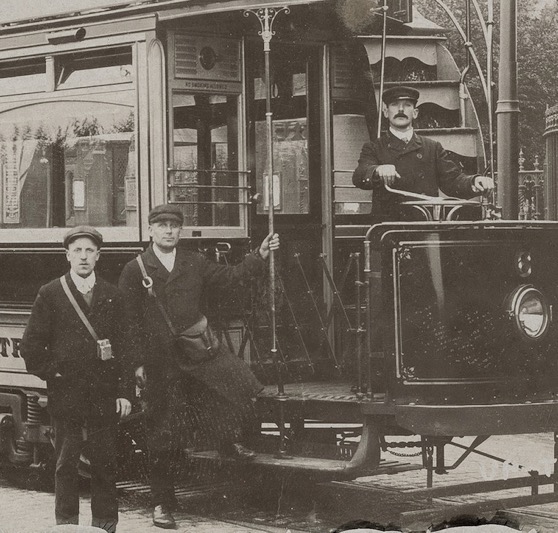
An enlargement of the above photograph showing the two conductors, both of whom are wearing informal attire.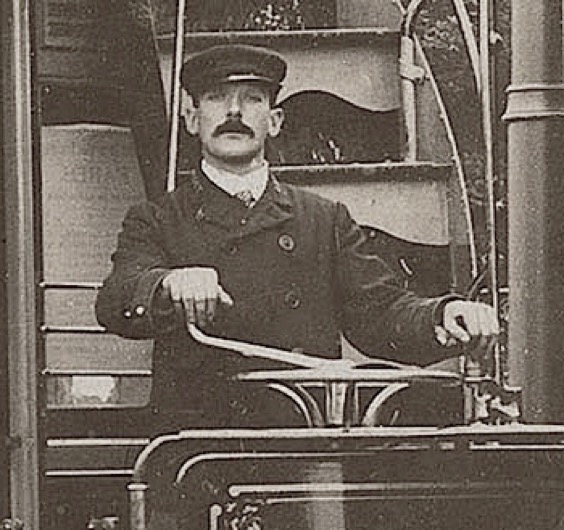
Another blow-up of the above photograph showing the motorman. His overcoat collars bear some form of initials, whilst his soft-topped cap appears to be devoid of insignia.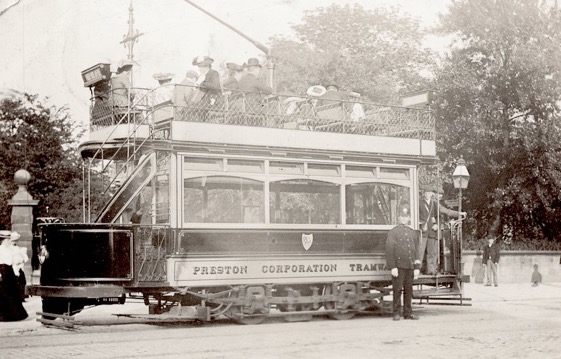
Tramcar No 6 again, clearly in pristine condition, and in revenue-earning service — photo undated, but almost certainly taken in 1904. Richard Rosa Collection.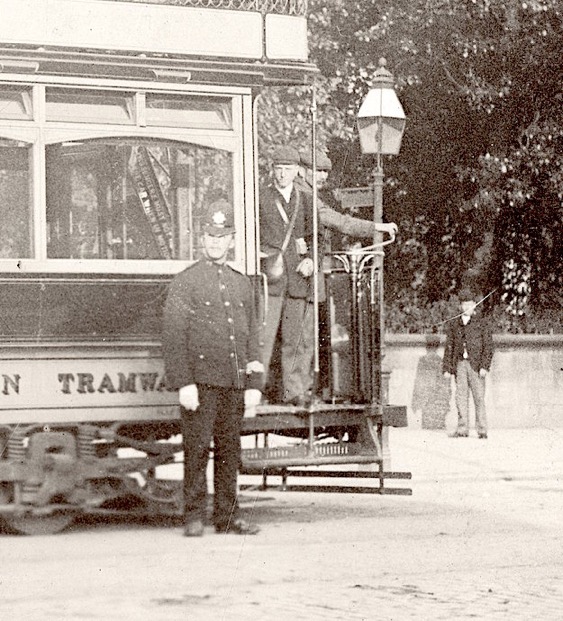
An enlargement of the above photograph showing the crew, both of whom are wearing informal attire, inclusive of cloth caps.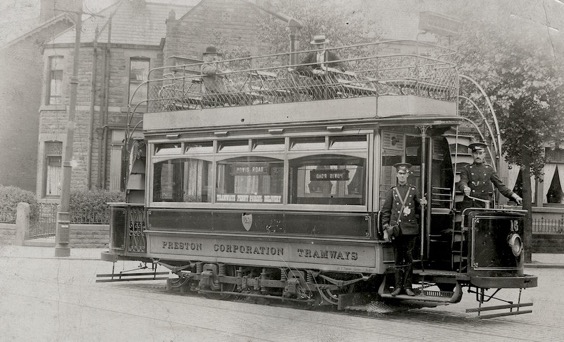
Motorman R. Watton at the controls of Tramcar No 15 in Tulketh Road — photo dated 1904. Photo copyright of the Harris Museum and Art Gallery, Preston; courtesy of the Harris Museum and Art Gallery, Preston (see link).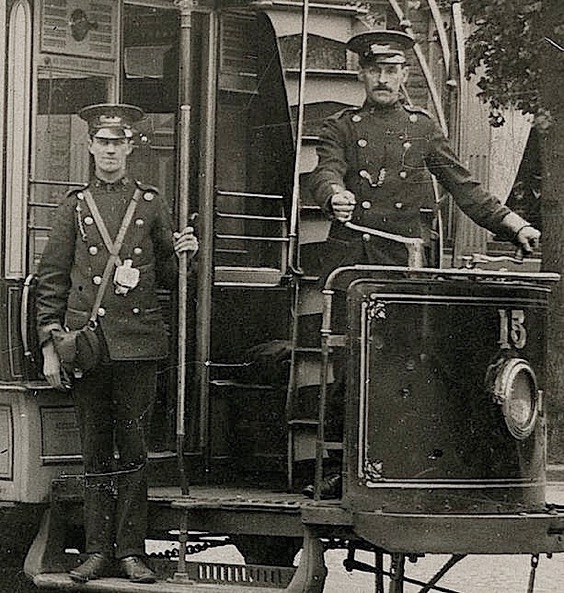
An enlargement of the above photograph showing the conductor and the motorman, both in smart new uniforms with tensioned-crown peaked caps bearing their grades – 'Conductor' and 'Driver'.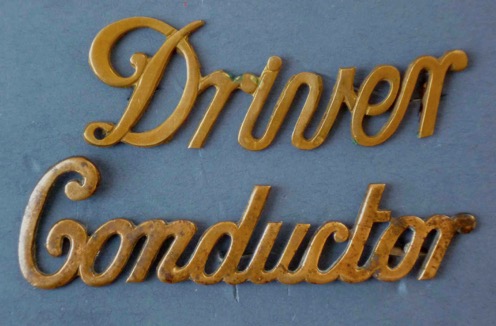
General pattern script-lettering grade badges of the type used by Preston Corporation Tramways – brass. Author's Collection.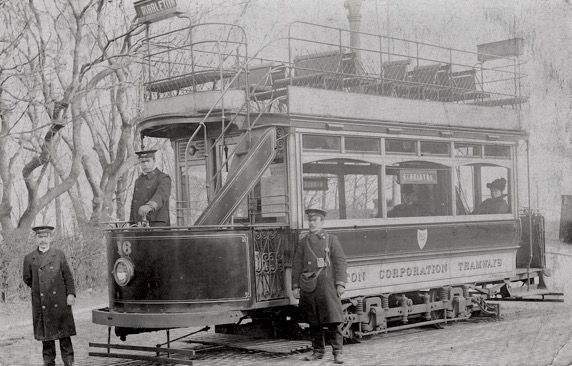
An inspector, a motorman and a conductor pose with Tramcar No 16 — photo undated, but probably taken in the mid-to-late Edwardian era. Photo copyright of the Harris Museum and Art Gallery, Preston; courtesy of the Harris Museum and Art Gallery, Preston (see link).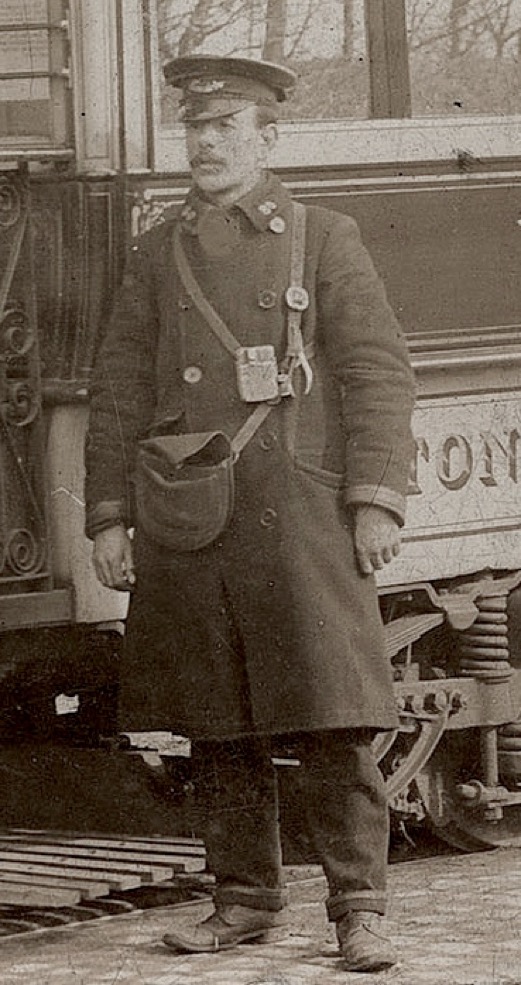
An enlargement of the above photograph showing the conductor (possibly Employee No 89) in his double-breasted greatcoat, which bears non-metal unmarked buttons.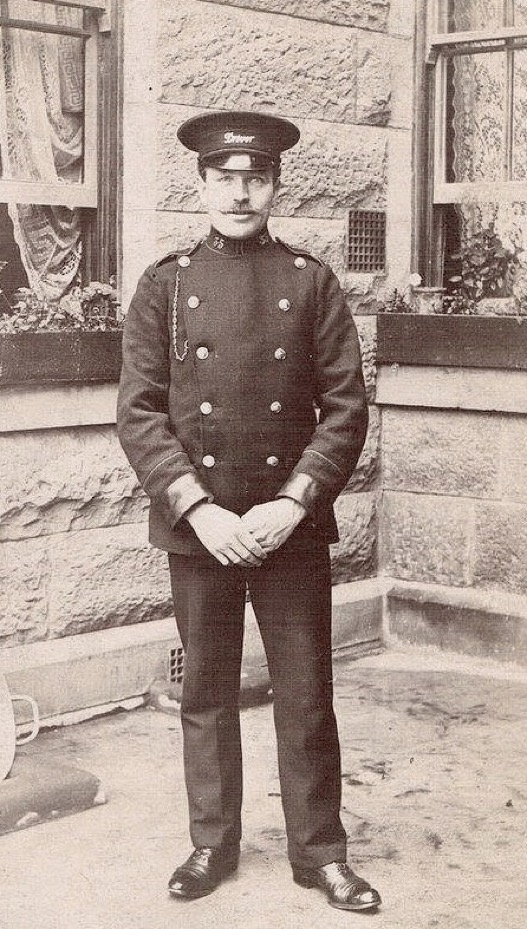
A PCT motorman (employee No 35) — photo undated, but from the moustache, probably Edwardian. Photo courtesy of Graham Willans, via the Preston Digital Archive (see link).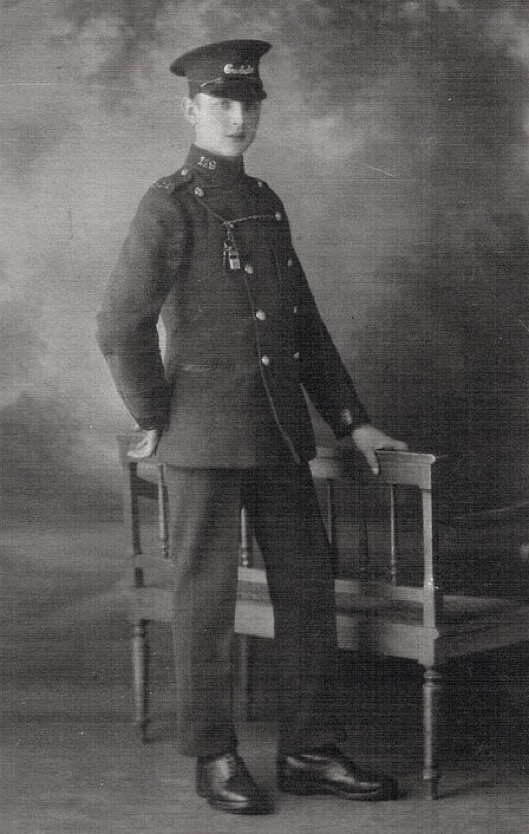
A rather youthful-looking PCT conductor (employee No 119). Whilst his collars clearly display his employee number, the epaulettes would appear to have system initials, 'P C T'. Photo courtesy of Graham Willans, via the Preston Digital Archive (see link).
An excellent studio portrait of another youthful-looking Preston Corporation Tramways conductor, this time of Employee No 76 — photo undated, but possibly late Edwardian or a little later. The photograph was taken in the studios of J. H. Jamieson of 91 Fishergate Preston. Author's Collection.
An enlargement of the above photograph showing details of the cap, collar and epaulette insignia, the latter clearly bearing 'P C T' system initials.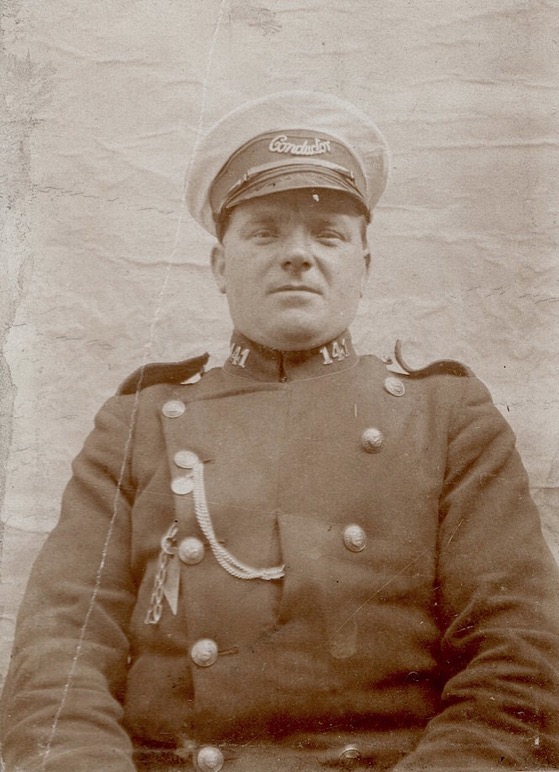
Preston Corporation Tramways conductor (Employee No 141) in his lancer-style tunic — photo undated, but possibly taken in the 1920s. Author's Collection.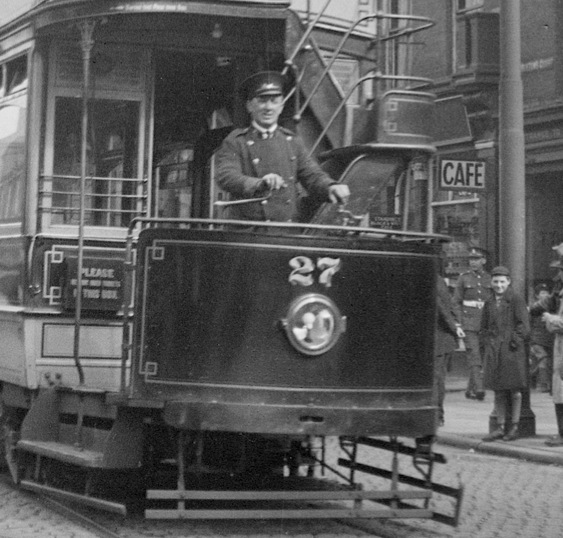
A Preston motorman at the controls of Tramcar No 27 with a service bound for the football ground — photo undated, but probably taken in the early 1930s. Photo by M J O'Connor, courtesy of the National Tramway Museum. 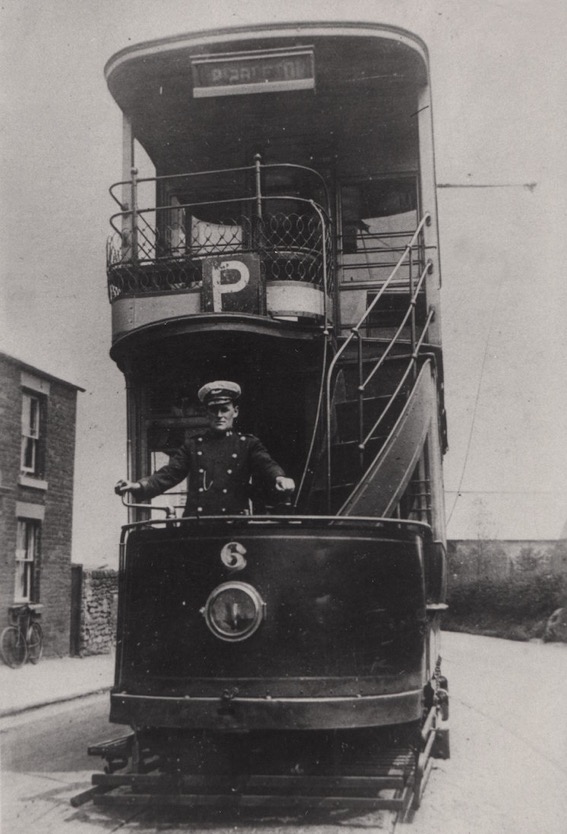
A motorman poses for the cameraman at the controls of Tramcar No 6 at the Ribbleton terminus with a service for Penwortham — photo undated, but probably taken not long before the latter closed in July 1932. Photo courtesy of Preston Digital Archive (see link).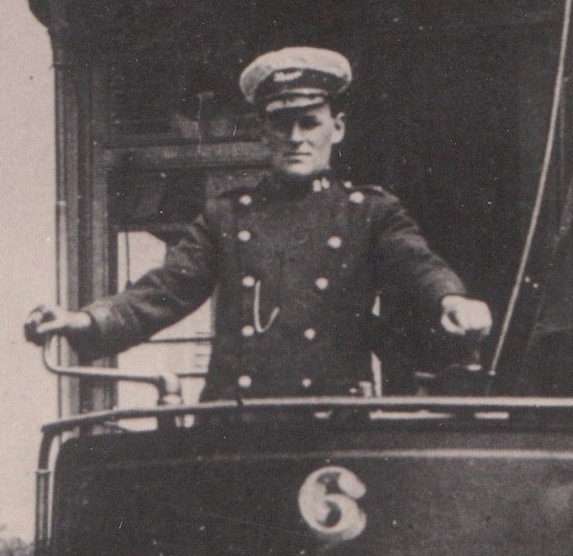
An enlargement of the above photograph, revealing the motorman to be Employee No 24.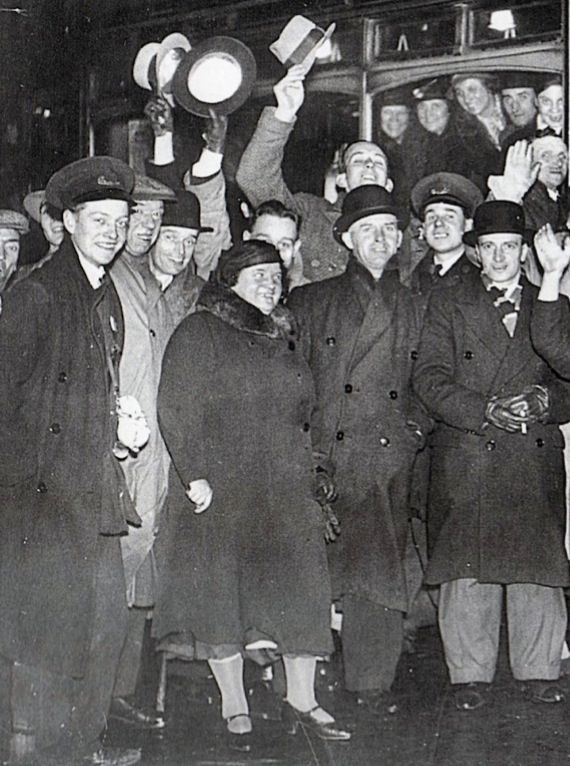
A conductor and a driver amongst the throng at Fulwood celebrating the last Preston tram on the 15th December 1935. Photo courtesy of Preston Digital Archive (see link).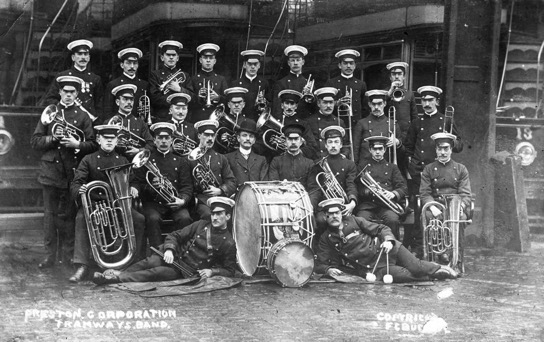
A photograph of the members of Preston Corporation Tramways Band — photo undated but probably taken in the mid-Edwardian era. Photo courtesy of the National Tramway Museum.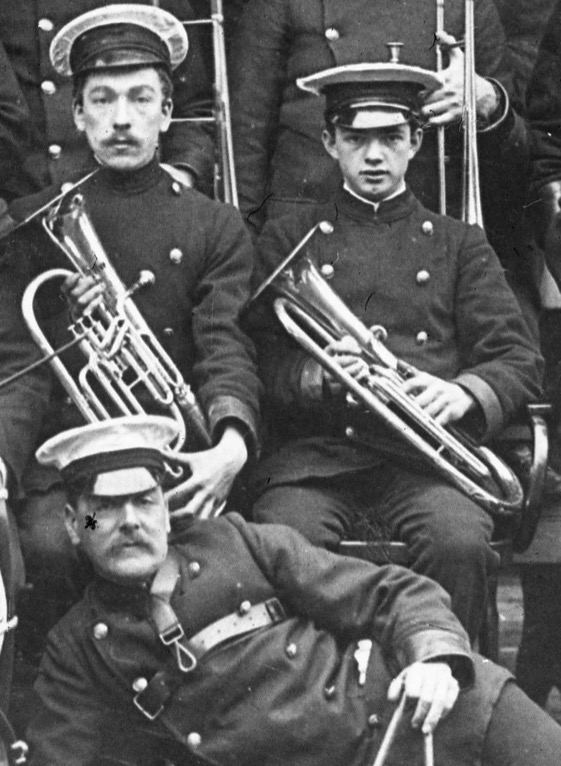
An enlargement of the above photograph showing some of the men. Whilst it is tempting to assume that the men are wearing their standard uniforms with all the insignia removed, this is probably not the case as these uniforms have no epaulettes.
Senior staff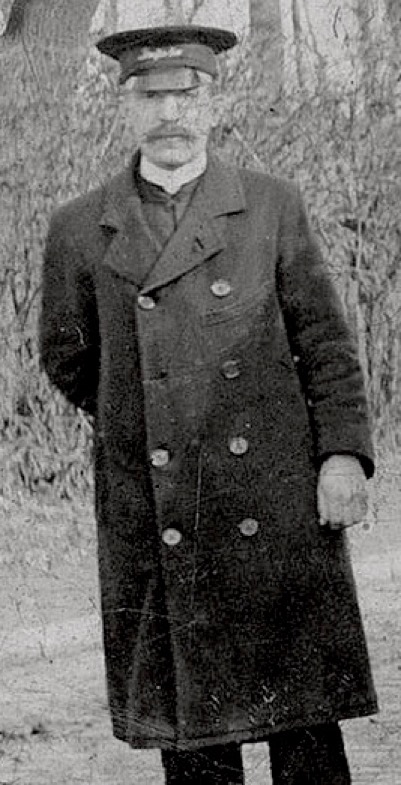
An enlargement of the photograph of Tramcar No 16 (mid-to-late Edwardian) showing an Inspector. He is wearing an unmarked overcoat, but clearly has his grade — 'Inspector' — on a hat band on his tensioned-crown peaked cap.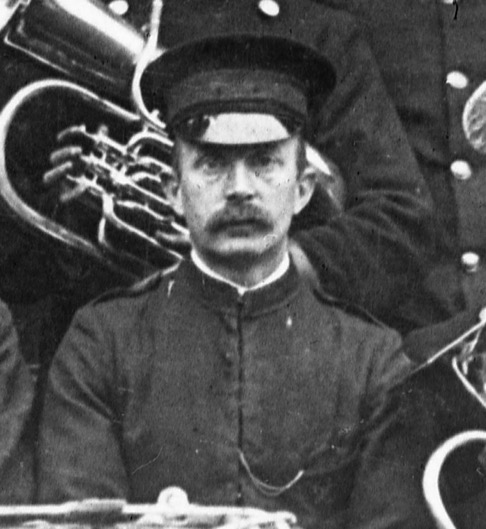
An enlargement of the Tramways Band photograph above showing the inspector. He is probably wearing his standard uniform as one of his collars, at least, appears to bear his grade in embroidered script lettering.
Female staff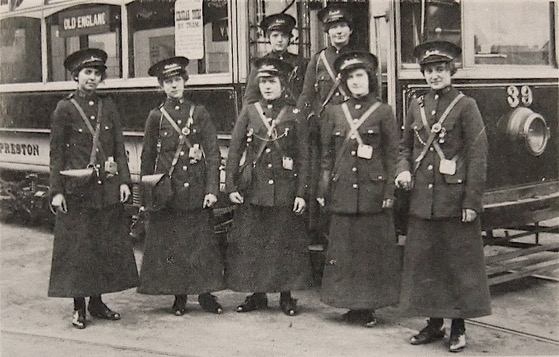
A group of conductresses (possibly referred to as 'conductorettes' in Preston) pose alongside Tramcar No 39 — photo undated, but almost certainly taken during the Great War or shortly afterwards. Photo courtesy of Preston Digital Archive (see link).